
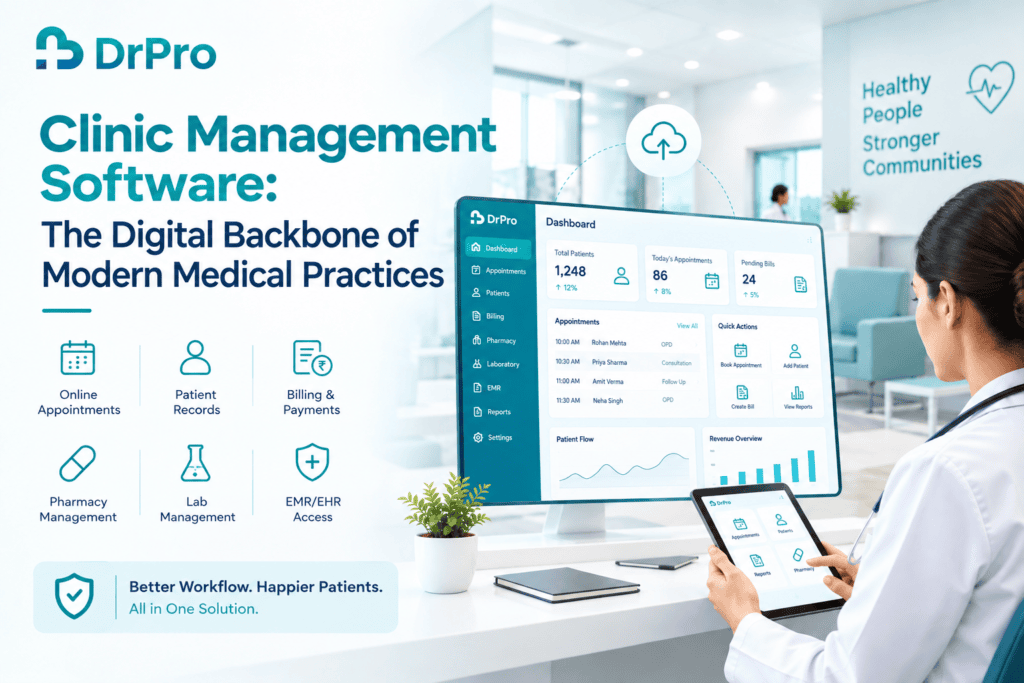
A modern medical practice includes the general running of a clinic and not just looking after patients. This means that doctor teams and clinic staff need to take care of appointments, medical records, accounts, prescribed medication, laboratory services, pharmacy, inventory, communication, and daily tasks. Manual methods or disconnected software for all these things can hinder clinic management as the patient list grows.
Clinic management software can thus be of great value in a modern medical setting and organize useful clinical and administrative procedures all in one accessible location, saving teams many tedious repetitive tasks and facilitating everyday office activity.
What Is Clinic Management Software?
Clinic management software is an electronic information system to help medical practices maintain their daily activities. It can involve, depending on the software available, taking bookings, patient registration, electronic records, billing, and so on, and furthermore, prescription management, pharmacy management, laboratory management, inventory management, reporting, and patient communication features.
The advantage compared to having separate systems to carry out tasks like taking bookings, medical records, or billing is linking processes. This allows for a seamless process from when patients make their first appointment until they leave with their prescription paid for.
Doctors and clinic managers now have immediate access to data with information properly organized instead of having it filed in paper files or dispersed between several different applications.
Why Modern Clinics Need Digital Management
Practices in the health care profession are now more patient- and technology-based than ever. Patients are demanding quick and convenient appointments, easier sign-in and registration procedures, reduced wait times, correct charts and files, and improved communication channels.
However, clinic owners require control and insight over operating expenses, staff efficiency, patient volume, billing, inventory, and the performance of their practice.
Manual processes can create several problems:
- Difficulty in finding patient records.
- Appointment schedules can be disorganized.
- Administration is increased.
- Entries are repeated by staff due to missing or confusing information.
- Management of medication and inventory levels can become problematic.
- Performance metrics for the clinic difficult to ascertain.
- Patient interaction can be variable.
Such a digital management system can bring about order to the running of those activities and simplify accessing that data.
It’s not just about moving from paper onto computers. The general idea is to establish an interrelated workflow where information can readily be moved to and from any part of the clinic.
Essential Features of Clinic Management Software
One could also include more complex functionality within one platform:
Appointment Management
Appointment scheduling is a crucial day-to-day task in a medical practice. There are also various ways a medical practice staff may benefit from using a software package, such as appointment scheduling, doctor schedules, changing or rearranging appointment dates, and general calendar planning.
The development of an efficient scheduling system can minimize conflict issues among appointments and allow staff to have a clear understanding of patient schedules for the day.
Digital Patient Records
Patient data is at the heart of all healthcare provision, and using digital records helps you organise and manage patient data, the medical record, consultation details, diagnoses, prescriptions, and all reports relating to a patient.
As an approved healthcare practitioner, you will only be granted access to the relevant data required for a given situation, thus eliminating the reliance on physical data files and offering an easier way to manage the information that you require.
EMR and EHR
Clinics can use Electronic Medical Records and Electronic Health Records to keep patient data online. With links to other workflows in the practice, the electronic records can be used for the doctor to take notes on consultations, retrieve past data, and file patient histories without the need for other methods to be followed.
Billing and Payments
The same applies to billing administration. Using clinic management software to create invoices and payments, as well as for record-keeping, saves time and effort on administrative duties.
Linking the billing to both the calendar appointment section of the software and the patient file can reduce double data entry and help improve financial record-keeping.
Pharmacy Management
In clinics that run an on-site pharmacy, we should track medicines, stock, sales, and corresponding activities.
Managing pharmacy functions could assist employees in having a much-improved overview of medications on the shelves and working on pharmacy in conjunction with clinic activity.
Laboratory Management
Additional or organized diagnostic capabilities may also be available at some clinics. Lab features assist in test orders, patient information, workflow, and lab reports, which can be a way to manage and organize them.
Connecting lab information to patient information may streamline health care providers’ efforts in managing diagnostic information.
Queue and Token Management
Patient waiting time is one aspect that affects the general feeling towards the clinic. Queue and token management are also features that assist staff in orderly management of patients’ flow and their appointments. The facility would be very helpful for the busy OPD, where quite a few patients come around the same period of time.
Inventory and Supplier Management
In the medical field, medicines, equipment, disposables, and other medical supplies are routinely used. Stock levels cannot be easily assessed, and it is not always straightforward to re-order stock from this manually managed inventory list.
Digital inventory management can be used by clinics to account for stock, procurement of supplies, details of suppliers, stock usage, and to achieve improved inventory management visualization.
Patient Communication
Communication does not just begin when an appointment is scheduled; patients also need appointment confirmations, reminders, follow-up notifications, and other alerts.
With appropriate platforms, automated communication features allow for more comprehensive communication management at the clinic and alleviate repetitive tasks for staff.
How Clinic Management Software Improves Daily Operations
The true benefit of a digital clinic management solution is connecting processes together.
Think of a patient journey. The patient books an appointment and is registered; upon arrival, the staff is kept informed of the registration and queueing stage. Doctors use the relevant patient data, document the consultation, and are able to append a prescription or lab request and record any patient billing and payment details on return.
If each function is being managed through a distinct piece of software, it can be that the same data ends up having to be entered many times by clinic staff.
Through the integrated clinic management solution, all the steps listed above will simply link to one another, integrated into one flowing digital process.
This allows for less data duplication, an improved flow, and less work for administrative staff on unnecessary re-entry.
The Role of Automation in Modern Clinics
Increasing use of automation in administrative practices in healthcare seems to have a significant role to play.
Every day, a clinic has a lot of routine tasks like handling appointments, registration, preparing invoices, reminders, generating reports, and updating records.
To remove certain tasks from clinicians’ working list and make them consistent, we need appropriate automation.
Automation is not about replacing the doctor or healthcare staff at all; it just gives our staff more time to concentrate on patients and more critical issues that involve clinically focused work. As we eliminate many monotonous administrative tasks, it increases the ability of clinic staff to utilize their time more efficiently.
Why Cloud-Based Clinic Software Matters
Allows your clinic’s system to be remotely accessible on permitted devices and no longer relies on only one machine at your clinic’s office.
This is good to utilize for medical practices that are developing, especially clinics with multiple providers, divisions, and locations.
Cloud-based clinic software can support:
- Consolidation of info
- Remote access via permitted devices
- Simplifies updates to the software
- Less need for reliance on existing physical setup
- Ability to scale as practices grow
- Multiple users and locations supported
Clinics will need to review security, privacy, access management controls, backup procedures, and data protection before implementing cloud-based healthcare.
How to Choose the Right Clinic Management Software
Your individual practice will have specific needs. A sole practitioner practice may look for the ability to handle appointments, patient histories, prescriptions, and billing, while a larger clinic would seek capabilities in pharmacy, laboratory, inventory, staff control, reporting, and multi-location use.
As you evaluate platforms, consider these areas.
Ease of Use
Software must be easily understandable and usable by the medical professionals, receptionists, administrators, and staff.
Feature Coverage
Select a system that streamlines the actual workflow of your practice instead of buying features you don’t use.
Scalability
Ability to cater for future needs. Doctors, departments, services, or locations can be added.
Security
Patient data is sensitive. How well is it secured? Clinics should consider authentication, user authorization, data access controls, backups, and data protection.
Integration
A connected system would be even more beneficial, where the appointment, recording, billing, pharmacy, lab, and stock flows are all integrated together.
Support and Training
The whole practice team can benefit from good onboarding, training, tech support, and customer service.
How DrPro Supports Modern Clinic Operations
DrPro’s platform provides an integrated digital model for the practice of modern health services.
The platform has been architected in such a way that it facilitates key practice workflows like Appointments, Patient Records, OPD Management, Billing, Pharmacy, Lab Management, Inventory, Communication & various other health services.
By integrating several functions within a single platform. DrPro can also serve as a tool through which practices rely less on isolated applications and conduct their day-to-day activities within a systematic framework.
With increasing numbers of medical facilities, the connectivity of the workflow could also help standardize operations, along with improving accessibility & visibility.
The Future of Digital Clinic Management
So it would seem that for clinical management, the future isn’t just about going paperless, but cloud, automation, analytics, AI, digital communication, and interconnected systems are also transforming practices. However, technology is only of value if it has a real problem to solve.
The most useful health technologies are the ones that support cutting administrative burden, improve record-keeping, enhance operational efficiency, and benefit the patient experience.
This is why clinic management software will become much more than just an administrative tool but a digital backbone for the modern practice.
Conclusion
Effective management of modern medical practice involves a dual approach of delivering superior patient care while managing operations efficiently. As a clinic expands, attempting to effectively coordinate appointments, records management, billing, pharmacy, laboratory operations, inventory, and communication manually can swiftly become challenging.
Clinical management software offers a viable approach to consolidating these tasks within a single structured system. Appropriate software has the potential to streamline routine administrative functions, enhance data accessibility, enhance patient care pathways, and grant clinic managers valuable insights into the day-to-day activities.
With the increasingly digital landscape of healthcare, implementing a sound, capable, and scalable clinical management solution will enable a medical practice toward a more efficient, seamless,s and patient-centric future.