

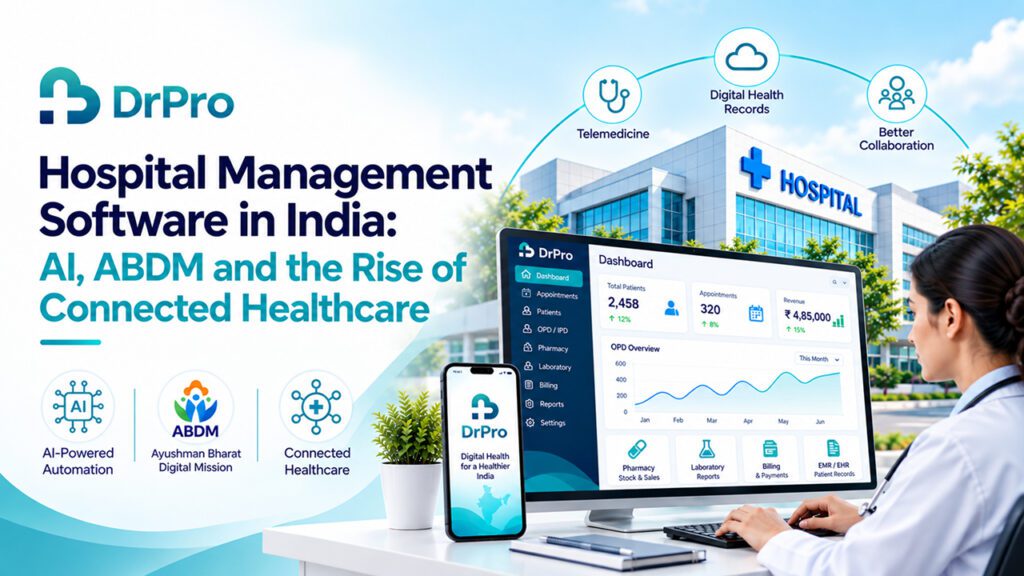
Digital healthcare is growing rapidly in India. Beyond paper records and siloed applications, hospitals and healthcare providers are turning to applications that will enable them to connect patient, administration, billing, diagnostics, pharmacy, and hospital management.
That revolution is being driven by hospital management software.
Contemporary hospital management software is not just for billing or appointments. All the workflows, such as patient registration, OPD, IPD, EMR/EHR, laboratory, pharmacy, inventory, billing, reporting, telemedicine, etc., can be connected into a single platform.
Meanwhile, artificial intelligence (AI) and the Ayushman Bharat Digital Mission (ABDM) are the two reasons why and how technology is leading healthcare in India into a different ball game altogether.
The power of AI is opening up new opportunities for automation, analytics, workflow, and patient engagement. ABDM is developing digital health infrastructure that will enable eligible ecosystems to facilitate interoperability and consent-based exchange of health information.
These innovations are directing hospital management software toward a more connected form of medicine.
This guide covers: How hospital management software in India is changing; how AI and ABDM fit; the modules hospitals require from their connected hospital management system; and what healthcare orgs should consider when selecting a connected hospital management system.
What Is Hospital Management Software?
Hospital Management Software is a web-based digital platform that enables hospitals to carry out clinical, administrative, financial, and operational activities of the organization from a single system.
A hospital management system may encompass:
- Patient Registration
- Booking Appointments
- PD Management, IPD Management
- Admission & Discharge
- Bed Management
- Doctor & Staff Management
- EMR/EHR
- Digital Prescription
- Billing & Invoice Management
- Pharmacy Management
- Lab Management
- Inventory Management
- Supplier & Purchase Management
- Queue & Token Management
- Reports & Analytics
- Patient Engagement & Communication
- Telemedicine
- Multi-Branch Management
It’s not just about getting individual digital functions.
The larger vision is to enable hospital workflows to be connected for information to flow seamlessly among authorized teams.
For instance, a patient’s journey can flow from appointment and check-in to consultation, testing, pharmacy, billing, and follow-up, without employees having to retype the same data across multiple systems.
Why Hospital Management Software Is Important in India
Hospital Management Reality in India
A small nursing home, multi-specialty hospital, diagnostic center, or large hospital network may have very different processes and technology needs.
However, many organizations face similar operational challenges:
- Patient data overload
- Manual paperwork
- Multiple departments
- Multiple data entry
- Lengthy billing cycle
- Pharmacy & inventory
- Lab management
- Waiting lines for appointments
- Disassociated patient data
- Difficult to get instant reporting
Here’s how a connected hospital management system can digitize these activities.
This, and thus the importance of having the right digital tools, increases as health systems move to electronic records and online services, the cloud, automation, and digital health infrastructure.
It is also working towards increased interoperability within India’s digital health ecosystem.
According to government information, ABDM will aid in common standards and registries for health data, and in safe data sharing based on patient consent.
How AI Is Changing Hospital Management Software
AI is emerging as a technology sector in healthcare software.
But it is not about replacing the doctor or auto-medicating.
One of the most tangible benefits of AI in the real world is assisting with low-end administrative activity, data pattern recognition, optimizing operational efficiencies, and empowering healthcare teams to interact with data more effectively.
1. Smarter Appointment Management
Appointment trends, physician scheduling, patient movement, and scheduling data can be analyzed using AI-enabled systems.
This can assist hospitals in planning staffing with regard to busy times of the year.
2. Patient Flow Optimization
Hospitals deal with continuously changing patient volumes.
AI and analytics may also be able to give your team insights on past and current patterns of work to inform decisions about queues, appointments, beds, admissions, and discharges.
It’s about supporting hospitals to use their resources more effectively.
3. Automated Administrative Tasks
Many hospital activities involve repetitive work.
Automation with AI can be used for: Collecting, sorting, and summarizing information; sending reminders; and running your daily processes.
This helps the team get on top of admin and focus on what matters more.
4. Data-Driven Decision Making
Information is generated by the hospital management systems.
AI and analytics can be used to turn this data into actionable insights such as patient volumes and revenue, inventory, appointments, activity, and departmental and operational performance.
5. Patient Communication
Communication Solutions with AI/Augmented Intelligence can be used for appointment reminders, requests for information, follow-up, and various other patient communication workflows.
The full range of capabilities will vary based on the software involved and the hospital’s configuration.
What Is ABDM and Why Does It Matter?
The mission aims to create a national digital health ecosystem for India – the Ayushman Bharat Digital Mission (ABDM).
ABDM is designed around digital health infrastructure, facility registry, professional registry, digital health record, and exchange of information.
One key thing to remember is that ABDM isn’t just one big collection where everyone’s health information is stored. According to government information, ABDM facilitates approved data sharing among relevant stakeholders with a patient’s consent, using a privacy-by-design framework.
ABDM has also set common standards and registers that are designed to enable interoperability of various digital health systems.
That is, this means digital health software for hospitals will need to focus more and more on interoperability rather than hospital administration.
How ABDM Can Influence Hospital Management Software
ABDM is reshaping the mindset of healthcare organizations when it comes to digital systems.
A hospital management platform isn’t simply supposed to function as an information storage device anymore.
As healthcare becomes more interconnected, hospitals may require systems that can actually take part in much larger digital health flows.
1. Digital Health Records
Electronic records: facilitate the generation of more structured digital information, which can be easier to manage than physical records.
2. Interoperability
ABDM enables the interoperability of the digital health systems participating through common standards and shared registries.
It matters because a patient can visit more than one provider over the course of their health care.
3. Consent-Based Information Exchange
ABDM’s model principle is based on an informed and consent-based exchange of health data.
This highlights the importance of privacy and restricted access as factors for hospitals to consider when choosing a digital health app.
4. Health Facility Connectivity
ABD ecosystem incorporates a Health Facility Registry, which offers facilities a digital ID and makes them discoverable within the ecosystem.
5. Digital Health Adoption
Further, the National Health Authority has implemented measures to motivate hospitals, clinics, laboratories, and digital solution providers to join the ABDM ecosystem.
In terms of hospitals, the takeaways are clear: digital health software must be developed with connectivity and interoperability at its core.
Key Modules of Hospital Management Software
A connected hospital management platform usually combines multiple modules.
1. Patient Management
Patient management includes registration, demographics, history, visits, appointments, and other patient-related information.
A central Patient record decreases the existing burden of having to manage information across a number of isolated files.
2. OPD Management
OPD software takes care of outpatient registration, doctor appointments, queue, prescription, bill generation, and follow-up.
This is especially for hospitals that see a high volume of outpatients in a day.
3. IPD Management
IPD workflows can include:
- Admission
- Bed allocation
- Ward management
- Doctor assignment
- Nursing workflows
- Treatment information
- Patient transfer
- Discharge
Linking these steps can assist hospitals in streamlining inpatient service management.
4. EMR/EHR
Electronic records support clinicians in keeping clinical information organized.
- Depending on the system, this may include:
- Patient history
- Diagnoses
- Consultation notes
- Prescriptions
- Vitals
- Laboratory reports
- Treatment information
5. Billing Management
The system can handle consultation charges, procedure codes, room charges, lab charges, pharmacy charges, payments, discounts, invoices, and financial reporting.
6. Pharmacy Management
A hospital pharmacy module enables hospitals to take care of their medicine stock, prescriptions, purchases, sales, vendors, expiry details, billing, etc.
7. Laboratory Management
Laboratory software links the test request with the sample collection, processing, results, and digital reports.
8. Inventory Management
There is a requirement for the hospital system to track medicines, consumables, supplies, and equipment.
Inventory software can give you insight into inventories, purchases, suppliers, consumption, and expiry dates.
9. Reports and Analytics
Hospital administrators require accurate information about operations.
- Reports can cover:
- Patient visits
- Revenue
- Billing
- Admissions
- Discharges
- Pharmacy
- Laboratory
- Inventory
- Appointments
- Department performance
Benefits of Connected Hospital Management Software
The move toward connected hospital software can provide several operational benefits.
1. One Source of Information
Rather than recording data in disparate systems, hospitals can build a comprehensive digital platform.
2. Less Repetitive Work
Incorporated workflows can reduce repetitive data entry between divisions.
3. Faster Information Access
Staff with authority are able to review patient and operational information on an electronic device.
4. Better Department Coordination
Connected workflows can be used by reception, doctors, nursing teams, labs, pharmacies, billing teams, and administrators.
5. Improved Reporting
Having all the data in one place can help you compile financial and business reports.
6. Better Patient Experience
Digital appointments, organized registration, quick report turnarounds, and more efficient billing help create a seamless experience.
7. Scalability
Modular and cloud-based applications allow healthcare organizations to expand their user base, locations, departments, and services over time.
What Should Hospitals Look for in Hospital Management Software?
Relying on the quantity of features alone when selecting software can cause issues.
Hospitals need to ask if this system is suitable for their actual work situation.
1. AI Capabilities
If AI capabilities are crucial, hospitals will want to know precisely what the AI does, what data it uses, what human interaction is needed, and how this feature integrates into current workflows.
2. ABDM and Interoperability
Hospitals aiming to be part of India’s digital health ecosystem need to assess the provider’s current capability for interoperability, method of integration, standards, and implementation considerations.
3. EMR/EHR
The system should enable the management of structured digital clinical records to support the hospital workflows.
4. OPD and IPD
Offices should verify whether all outpatient and inpatient workflows are being supported.
5. Pharmacy and Laboratory
Pharmacy and laboratory integrated modules may eliminate at least some of the disconnected departmental software.
6. Security and Access Control
Healthcare software contains sensitive information.
The healthcare organization must consider authentication, role-based access, backup, security controls, hosting, audit, and, where relevant, data-protection standards.
The Ministry of Electronics and Information Technology has issued the Digital Personal Data Protection Rules, 2025, and related framework for implementation. Your hospital needs to consider how your software vendor handles privacy and data-protection obligations that are relevant.
7. Cloud and Mobile Access
Information can be made available from a remote system to any device supported by it.
Hospitals need to pre-test on the basis of reliability, support, availability, access controls, and security before deploying the infrastructure.
8. Scalability
It must have the capacity to scale to accommodate future expansion, additional users, departments, branches, and volume of patients.
What Should Hospitals Look for in Hospital Management Software?
How to Choose Hospital Management Software in India. No single hospital management software is ideal for all places.
Before selecting a system, hospitals should ask:
Does the software match our workflow?
A multi-specialty hospital will require drastically different features from a small nursing home.
Can departments work together?
Verify if the integration of patient management, OPD, IPD, pharmacy, laboratory, billing, and inventory is actually connected.
Is the system easy to use?
Procedures for commonplace activities should not be complicated for the physician or staff.
Does it support integration?
Assess integrations with laboratories, payment systems, digital health systems, communication channels, or other systems that your organization uses.
Can it scale?
Consider future users, departments, branches, and services.
What support is provided?
Training, migration, onboarding, technical support,t and implementation can significantly influence adoption.
Why DrPro for Connected Hospital Management
DrPro is an AI-enabled healthcare management platform for hospitals, clinics, labs, pharmacies, and healthcare professionals.
It provides one integrated hospital management software that integrates OPD, IPD, appointments, patient records, EMR/EHR, billing, pharmacy, laboratory, inventory, reporting, and hospital administration.
In addition, DrPro provides ABDM/ABHA integration.
Modular design is used in connected workflows,d not in modular workflows.
For example:
Appointment → Registration → OPD → EMR → Laboratory → Pharmacy → Billing → Follow-Up
For inpatient workflows:
Admission → IPD → Bed Management → Treatment → Laboratory/Pharmacy → Billing → Discharge
Hospital and clinic management are part of the services provided on DrPro, together with laboratory, pharmacy, inventory, billing, and EHR/EMR.
This unified approach can be scaled to hospital size, departments, number of users, integrations, and implementation needs for hospitals pursuing progress from siloed processes to a central digital workflow.
The goal is simple:
Link your workflows. Structure your information. Smoother hospital operations.
The Future of Hospital Management Software in India
Next-generation healthcare technologies will, perhaps, not be characterized by single software modules, but rather by open and connected healthcare ecosystems, says Durga Mohan. Read more.
AI can support automation and analytics.
Cloud platforms can provide centralized access.
Digital records can reduce dependence on paper.
ABDM enables interoperability and consent-based data sharing across participating systems.
Each of these innovations can, in combination, revolutionize the hospital’s logistics and information flow.
Technology is not about gadgets.
Some benefits hospitals can get from the top hospital management software are listed below.
- Reduce repetitive administrative work.
- Connect departments
- Organize patient information
- Improve operational visibility
- Support digital clinical records
- Simplify billing
- Manage pharmacy and laboratory workflowsdigital hospital management system
- Improve inventory tracking
- Support interoperability
- Provide actionable reports
- Scale with organizational growth
This is not about making health care more complicated with more technology.
It is intended to make healthcare activities more streamlined, integrated, and controllable.
Conclusion
Digitisation is just the beginning of how hospital management software in India is evolving.
Hospitals are searching for integrated solutions that can combine patient information, clinical information, OPD, IPD, billing, pharmacy, lab, inventory, analytics, and communication.
Similarly, AI and ABDM are opening up new opportunities for automation, interoperability, and connected healthcare.
So, more than just storing information, the right hospital management system should enable healthcare providers to link workflows, minimize administrative burden, securely manage information, and position themselves for a highly connected healthcare future.
The doctors who are assessing an integrated platform can get DrPro, which is available and delivers hospital, clinic, laboratory, pharmacy, inventory, billing, EMR/EHR, and health records management from a single, integrated platform.
Connected healthcare starts with connected information.