

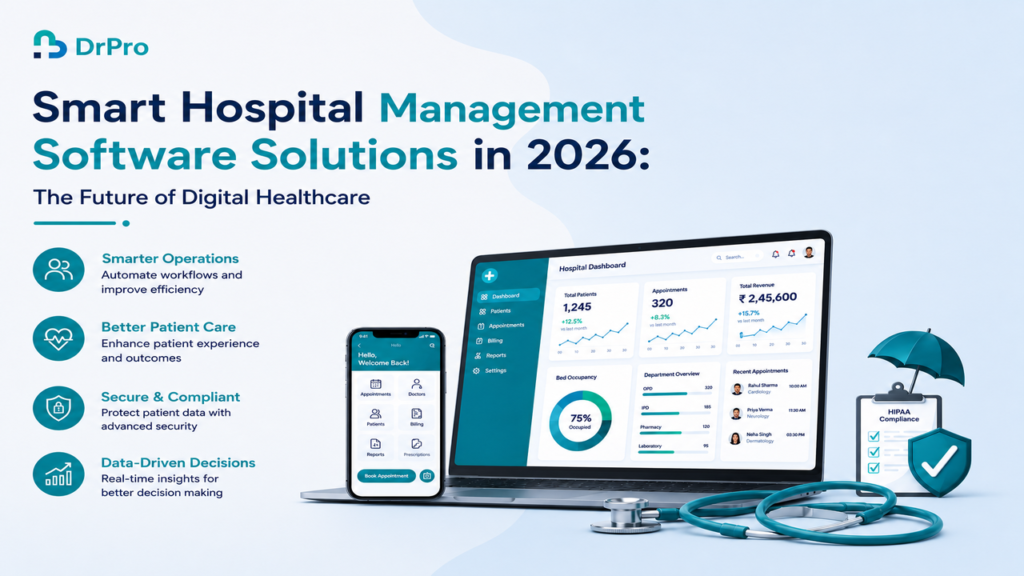
The healthcare industry of 2026 is emerging as smarter, faster, and more patient-centric than ever before. As hospitals and clinics gradually phase out the archaic, manual way of handling things, they are quickly adopting intelligent digital solutions that bring efficiency, improved patient care, and smarter healthcare management. Smart hospital management software is gaining traction in transforming the healthcare industry by providing organizations with solutions that could help in automating processes, minimizing paperwork, improving communication, and improving patient outcomes. From AI-based automation in healthcare software tocloud based medical record storage.
What is Smart Hospital Management Software?
Smart Hospital Management Software refers to a sophisticated computerized system that has the ability to manage each and every task and aspect of the functioning of a hospital or a clinic through a single software. It helps doctors and physicians, hospitals and clinics to control and streamline their operations, staff, patient records, and appointments, along with laboratory and pharmacy information, billing, and others.
Some of the technology areas that are being used to develop these systems in the year 2026 are:
* Artificial intelligence (AI)
* Cloud computing
* Automation
* Data analytics
* Telemedicine
* Mobile healthcare applications
These technologies enable health organizations to save time and operational costs and simultaneously enhance the well-being and health condition of their patients.
Why Smart Hospital Software is Essential in 2026
Hospitals now face more patient management tasks and administrative challenges with the rise in the number of patients to deal with. Existing manual hospital management systems can cause time delays, billing errors, communication problems, and problems with the data to be managed.
These problems can be solved with advanced hospital management software by providing intelligent automation and a system that enables complete healthcare management of the facility.
1. Artificial Intelligence Automation
AI is enabling hospitals to automate routine tasks, for example:
- appointment booking
- patient follow-ups
- billing procedures
- prescription handling
- report generation
This reduces human error, enabling medical professionals to spend less time on administrative work and more time with the patient.
2. Faster Patient Experience
Today’s patients expect instant and digital medical services. Smart healthcare software enhances patient satisfaction by providing:
- Book an appointment online
- Digital prescriptions
- Instant billing
- Quick check-in
- Automated notification system
- Easy access to medical records
This helps to have a seamless healthcare experience.
3. Centralized Hospital Operations
Smart hospital systems provide a unified hospital management system for all the departments of a hospital, including:
- OPD/IPD Management
- Laboratory Management
- Pharmacy Management
- Inventory Management
- Billing & Insurance
- HR & Staff Management
This streamlines operations for the hospital.
Top Features of Smart Hospital Management Software in 2026
Cloud-Based Accessibility
Cloud services enable doctors and administrators to access their patients’ data at any point in time from anywhere. The concept helps in efficient working at remote levels.
EMR / EHR
The electronic records about a patient help the doctors to make an accurate and immediate assessment with the patient’s history and make an appropriate treatment plan.
Smart Billing and Insurance Management
Smart billing software automates the entire payment process:
- Billing, claims management, and payment tracing
- Financial statements,
- accounting reports,
- GST calculation
- Reduces the error in billing
Telemedicine Integration
Telemedicine will further expand in 2026. Now Smart Healthcare Software will include the following;
- Video Consultations
- Online Prescriptions
- Remote patient monitoring
- Virtual follow-ups
This allows hospitals to deliver healthcare beyond physical locations
Real Time Analytics & Reporting
Advanced dashboards provide the following data in real time;
- Hospital’s performance
- Patient flow
- Revenue tracking
- Staff productivity
- Resource allocation
This allows better business decisions to be made
Latest Trends in Hospital Management Software for 2026
AI-driven predictive health care
Hospitals have begun to utilize predictive analytics in order to detect high-risk patients, predict admissions, optimize the schedule of staff, and allocate other resources.
Paperless healthcare systems
The adoption of electronic health records is streamlining administrative processes and moving toward sustainability.
Mobile healthcare apps
Patients and doctors are utilizing mobile applications to:
- Schedule appointments
- access reports and tests
- monitor medications
- communicate with their doctors
- process online payments
IoT and Smart Medical Devices
Internet-connected health devices are being utilized to monitor the health of patients and streamline emergency services.
Benefits of Smart Hospital Management Software
For hospitals:
- Streamlined hospital operations
- Faster patient admissions and discharges
- Effective departmental coordination
- Lower operational expenses
- Increased data security
For doctors:
- Swift access to patient records
- Streamlined scheduling
- Digital prescriptions
- Efficient treatment plan development
For patients:
- Reduced wait times
- Enhanced communication
- Convenient online services
- Improved overall healthcare experience
How to Choose the Right Hospital Management Software
In 2026, while choosing healthcare management software, hospitals will consider the following aspects.
- AI automated
- Cloud-Based System
- Easy and User-Friendly System
- Security of Data
- Flexibility & Customize
- Expandable
- Technical support
- Mobility
Choosing the right system can be beneficial for improving the operational effectiveness and the satisfaction level of patients.
Future of Smart Healthcare
The future of healthcare is digitized, interconnected, and smart. Hospitals with smart hospital management systems are turning smarter, patient-friendly, and technology-oriented. AI, automation, and cloud computing will keep on revolutionizing healthcare operations in the coming years, and smart hospital software is the key to the future of the modern health system.
Conclusion
In 2026, smart hospital management software solutions will have already begun revolutionizing healthcare by providing automation, smart workflows via AI, cloud accessibility, and an intelligent patient management system. These smart solutions not only help hospitals and clinics to operate with efficiency, decrease manual tasks, and increase patient care, but also make them profitable. Adopting smart digital healthcare solutions is not a choice any longer in the evolving health sector-it’s a requirement to provide the best possible, faster, smarter, and connected patient care in the modern age.