

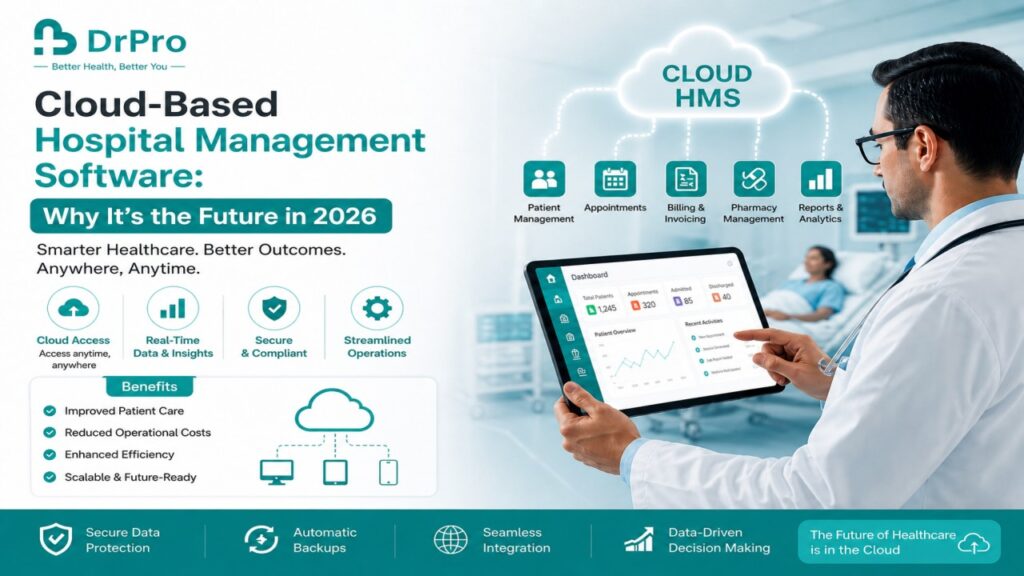
With rapid digital transformation, the healthcare industry is at the forefront in managing high-quality and efficient services with the advent of Hospital Management software. In 2026, Cloud based Hospital Management software has emerged as the most ideal approach, enabling hospitals and clinics to manage operations smartly and scalably.
From patients’ records, billing, and analysis, a cloud-based Hospital Management software provides the ease of work for healthcare professionals to optimize their workflow, increase savings, enhance patients’ health outcomes, and simultaneously ensure data security and accessibility.
What is cloud based Hospital Management software?
A centralized digital platform that is hosted in secure remote servers and enables hospitals to manage their clinical, administrative, and financial operations on a single platform, driven through an Internet-driven system and not on a traditional on-premise-based system.
It allows all essential hospital information to be saved, updated, and accessed in real-time with seamless functioning between departments.
Why Cloud-Based Hospital Management Software is the Future
1. Access to Information in Real Time
Access Anywhere and in Real time Access to patient health records, schedules, and reports from anywhere atany timeee, allowing swift and effective decision making. The real-time access features of the cloud-based HMS software allow efficient handling of cases by healthcare professionals.
2. Cost Efficiency and Scalability
Scalability & Affordability. Unlike on-premise solutions, where you need to purchase Hardware, have a data center for servers, and an entire team of IT professionals managing it, cloud-based HMS software works on a subscription basis, where you are charged monthly or yearly, thus significantly reducing upfront costs. This also makes the software easily scalable; you pay as you grow.
3. Enhanced Patient Care and Experience
Better Patient Care & experience. When all patients’ information is in a centralized database, it leads to more accuratediagnosisand the reduction of medical errors. Information about the patient will be instantly available to all authorized medical providers, which improves the coordination of care and ultimately enhances patient care. Scheduling appointments, reminders, followups become very simple.
4. Robust Data Security and Compliance
Security & Compliance Maintaining compliance with regulations is important, and you do not have to be worried anymore. Cloud-based HMS software ensures data security with technologies such as encryption, multi-factor authentication, automated data backups, and disaster recovery plans, and meets HIPAA and other privacy regulations.
5. Automates the Core Hospital Processes
Cloud-based Hospital Management software automates all the typical hospital procedures, such as billing, inventory management, reporting, etc. Thus, reducing the manual burden on staff, error possibilities, and ensuring more time for the health care providers to serve patients.
6. Integrate with advanced technologies
Integration with state-of-the-art tools such as Artificial Intelligence, telemedicine, and digital health platforms is very important in the year 2026. Cloud-based HMS is flexible enough for seamless integration. With the help of this integration, patients can undergo remote consultation, obtain smarter diagnoses, and access connected health care services remotely.
7. Data-driven decision-making
Hospitals can obtain better insights through performance monitoring, resource optimization, and efficiency improvements by using real-time analytics and reporting features of the HMS . Data concerning patients’ traffic, revenues, and staff’s working hours is helpful for overall planning and management.
Essential Features of Modern HMS
A comprehensive cloud-based Hospital Management software should include:
- Patient registration and EHR
- OPD & IPD Management
- Billing and Insurance Processing
- Pharmacy & Inventory Management
- LIS Integration
- Appointment & Scheduling system
- Reporting & Analytics Dashboard
- Mobile access and user friendly interface
Growing Adoption in India
The digital transformation, increasing patient load, and rapid adoption of Telemedicine are compelling hospitals of all sizes in India to shift toward cloud-based Hospital Management software that is flexible, secure, and cost-effective for small and medium hospitals and scalable for bigger ones as well.
Future trend
The future Hospital Management software will consist of a cloud-driven, intelligent, and connected ecosystem driven by data such as analytics for prediction, Internet-connected devices (IoT), voice commands, and a complete paperless hospital system. Cloud is powering further innovations in all sections of health care.
Conclusion
Cloud-based Hospital Management software is no longer a choice; it is a necessity for healthcare organizations to thrive in the competitive environment in the year 2026 and beyond, as they have provided the most advanced solutions that can make operations agile, improve patient care, and increase efficiency.
By migrating to cloud based Hospitals Management software, healthcare organizations can take the path towards a future and advanced healthcare system.
1. What is Hospital Management software?
Hospital Management software is a digital system designed to manage hospital operations such as patient records, billing, appointments, pharmacy, and reporting in a centralized platform.
2. What are the benefits of using Hospital Management software?
Hospital Management software improves efficiency, reduces manual errors, enhances patient care, automates workflows, and provides real-time data access for better decision-making.
3. Why is cloud-based Hospital Management software important in 2026?
Cloud-based Hospital Management software offers remote access, scalability, cost savings, and integration with advanced technologies like AI and telemedicine, making it ideal for modern healthcare.
4. Is Hospital Management software secure?
Yes, modern Hospital Management software uses encryption, secure servers, access control, and regular backups to protect sensitive patient and hospital data.
6. What features should I look for in Hospital Management software?
Key features include patient management, billing, appointment scheduling, pharmacy management, lab integration, reporting, and mobile accessibility.
7. How does Hospital Management software improve patient care?
By providing accurate and real-time patient data, Hospital Management software helps doctors make faster decisions, reduces errors, and ensures better coordination between departments.
10. How to choose the best Hospital Management software?
Choose Hospital Management software based on features, ease of use, scalability, pricing, customer support, and integration capabilities.