

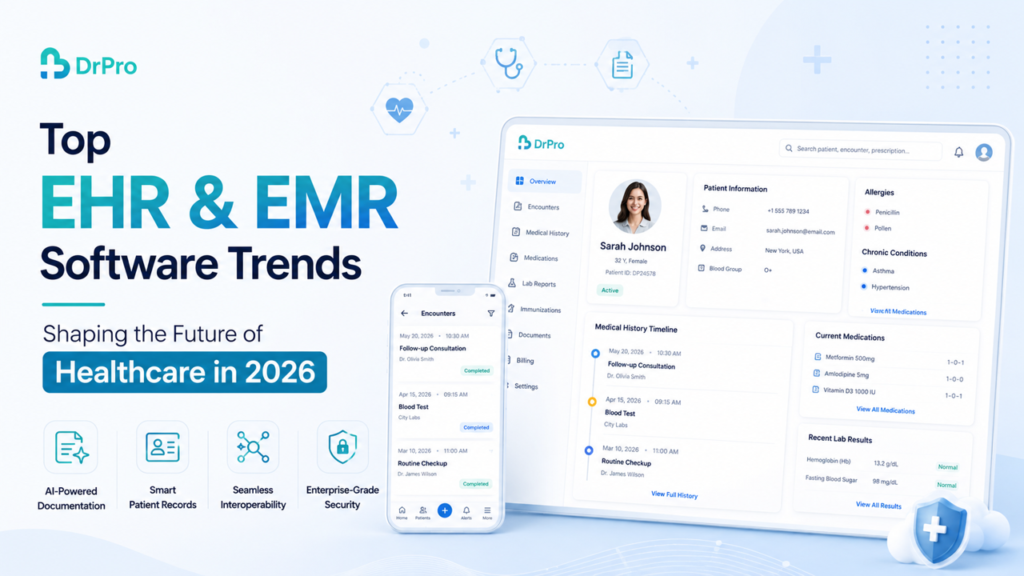
Healthcare is Entering a New Digital Era
Technology is radically transforming healthcare – more so than perhaps any other industry ever before. Hospitals, clinics, and healthcare practitioners are turning to smart digital solutions to support quality patient care, facilitate better outcomes, and facilitate greater efficiency.
Electronic Health Record (EHR) and Electronic Medical Record (EMR) Software is at the forefront of that transition. It’s moved beyond simply digitizing paper records to becoming a sophisticated healthcare system that instantly connects providers, patients, doctors, nurses, specialists, pharmacists, laboratories, and hospital networks.
This year’s top EHR & EMR Software innovations are supporting healthcare providers in providing more intelligent care to more patients – faster and more efficiently.
The Evolution of EHR & EMR Software
The Electronic Health Record (EHR) and Electronic Medical Record (EMR) vendors no longer need to just provide solutions to “just take and store clinical notes”. Modern-day organizations require and look for smarter and robust EHR and EMR solutions that assist in clinical decision-making, automation of workflows, seamless coordination, and improve patient engagement.
Modern EHR and EMR software have come a long way and have now become the technological backbone for operations in healthcare. It is one of the leading solutions integrating patient management, analytics, workflow automation, telemedicine, and interoperability in an open platform.
In the data-driven era, the need for EHR & EMR software is going to be only increased.
1. Artificial Intelligence is Revolutionizing Clinical Workflows
Today, Artificial Intelligence is the largest growing technologies introduced in EHR & EMR Software.
- We use AI in healthcare in ways like:
- Automating clinical documentation
- Writing intelligent patient summaries
- Anticipating health risks
- Improve diagnostic accuracy
- Assist with treatment planning
Minimize physician burnout. Our smart EHR & EMR Software helps providers free up their time in documentation and administrative tasks, and focus on more patient care.
2. Cloud-Based EHR & EMR Software Becomes the Industry Standard
Most healthcare facilities are now phasing out traditional on-premise systems for newer cloud solutions.
The advantages of using cloud-based EHR & EMR Software include:
- Accessible 24/7 from anywhere
- Real-time synchronization of patient records
- Reduced infrastructure costs
- Automated updates and maintenance
- Improved security with data disaster recovery
Cloud technology offers facilities greater flexibility and the scalability they need.
3. Interoperability is Driving Connected Healthcare
Healthcare’s focus has sharpened, making it incredibly important to share patient information freely and securely between any of your trusted healthcare providers.
Thanks to robust Electronic Health Record (EHR) and Electronic Medical Record (EMR) solutions that now provide strong interoperability, Connected Healthcare has helped usher in an era of:
- Quickly exchanging information
- Coordinating care more effectively
- Avoiding repeat testing
- Making better-informed choices about treatment plans
- Patient Safety
Ultimately, the connected care ecosystem is the Future ofhealthcare.
4. Predictive Analytics is Transforming Patient Care
Healthcare providers are increasingly using predictive analytics to move from reactive care to proactive healthcare management.
Modern EHR & EMR Software can analyze large volumes of patient data to:
- Identify high-risk patients
- Predict disease progression
- Improve chronic disease management
- Reduce hospital readmissions
- Support preventive care initiatives
This trend is helping healthcare organizations improve outcomes while reducing healthcare costs.
5. Telehealth Integration Continues to Expand
Telehealth is here to stay in healthcare. Telemedicine is a part of the modern healthcare landscape and is being integrated into new settings.
EHR and EMR software so you can:
- Take video calls with patients.
- Send online prescriptions.
- Manage patient health online.
- Make online appointment scheduling for them.
Telemedicine, or remote care options, increases health and care access.
6. Mobile-First Healthcare Experiences
Healthcare Providers Now Turning to Mobile Devices to Manage Patient Information. There is now a wide range of Electronic Health Record (EHR) and Electronic Medical Record (EMR) Software that provides full Mobile Access.
Now clinicians can :
- View Patient Records from Anyplace
- Enter and update Medical notes immediately
- View daily Schedules and alerts
- Interact with their care teams
Mobile medical tools help to boost productivity and allow the clinician to act more quickly.
7. Enhanced Data Security and Cyber Resilience
Patient data has long been under siege from malicious cyber-attacks, which means security is at a premium for any healthcare organisation.
Top Security Features Of Modern EHR & EMR Software:
- End-to-end encryption
- Multi-factor authentication
- Role-based permissions
- Real-time monitoring
- Automated back-ups
Healthcare organisations are investing millions of pounds in keeping their patient records as safe as possible.
8. Voice Technology and Ambient Documentation
Documenting patient encounters consumes much of a physician’s workday.
Leading EHR and EMR Software are now incorporating:
- Voice recognition
- AI-powered transcription
- Automated clinical notes
- Natural language processing
Such technologies are decreasing documentation needs and allowing doctors to focus on the patients.
9. Personalized and Patient-Centered Healthcare
Patients are actively involved in the treatment process.
New Electronic Health Record (EHR) and Electronic Medical Record (EMR) solutions offer online functionality for increased patient participation:
- Online Appointments scheduling.
- Client portal.
- Mobile Rx.
- Personal Health Information Access.
Secure Communication Patient-centered care results in increased loyalty, confidence, and overall health.
10. Data-Driven Decision Making
In healthcare, decision makers and administrators are leaning on timely and accurate information to guide their strategy, increase efficiencies, and deliver excellent patient outcomes.
When implementing or selecting an Electronic Health Record (EHR) and Electronic Medical Record (EMR) Software solution, decision makers need comprehensive reporting options, which give insights into their health data,
- including the following:
- Clinical performance
- Patient outcomes
- Resource utilization
- Revenue management
- Population health statistics
Using the health data to empower your organization.
Why EHR & EMR Software Is More Relevant Now Than Ever
EHR & EMR systems have become an indispensable part of modern health practices. To thrive in an era of continuous healthcare advancements, organizations must embrace systems that bolster their clinical and operational efficiency.
Contemporary EHR & EMR Software enables healthcare facilities to:
- Deliver superior patient outcomes
- Minimize administrative tasks
- foster greater health collaboration
- Bolster data security
- Guide digital transition
- Amplify operational efficiency
- Boost patient engagement.
These advantages make investing in Electronic Health Record and Electronic Medical Record software an essential step towards becoming a future-proof health facility.
Conclusion
In 2026, the future of healthcare is intelligent, interconnected, and the patient comes first. The most recent innovations in EHR & EMR Software are making it possible for all types of healthcare organizations to achieve higher quality care for their patients and also to improve efficiency and patients’ experiences. These EHR trends, ranging from artificial intelligence, predictive analytics, cloud solutions, and telehealth, are changing and improving the state of healthcare worldwide. Organizations looking to succeed should invest in smarter Electronic Health Record and Electronic Medical Record Software systems as the digital healthcare landscape transforms.