
The health sector is currently moving with unprecedented speed towards comprehensive digitisation. Even individual clinics and doctors’ offices are increasingly investing in technological solutions in order to ensure efficient patient care, optimise workflows, streamline administration, or provide data storage solutions for ever-increasing data volumes. Old-fashioned systems for managing appointments, patient records, billing, medication requests, and post-discharge care lead to laborious and poorly scalable work.
The task of managing appointments or keeping patient records up to date is a task that clinic management software covers efficiently, as all important areas in a clinic are effectively connected in a comprehensive system.
For modern healthcare professionals, effective clinic management means more than just being able to file away patient documents or make appointments. It’s about using connections in modern healthcare in the best possible way so that doctors, employees, and patients can communicate with each other at the same time, and all data remains at the same level.
What Is Clinic Management Software?
A clinic management software is a digitally driven solution where a healthcare professional is able to manage his/her clinic or practice daily.
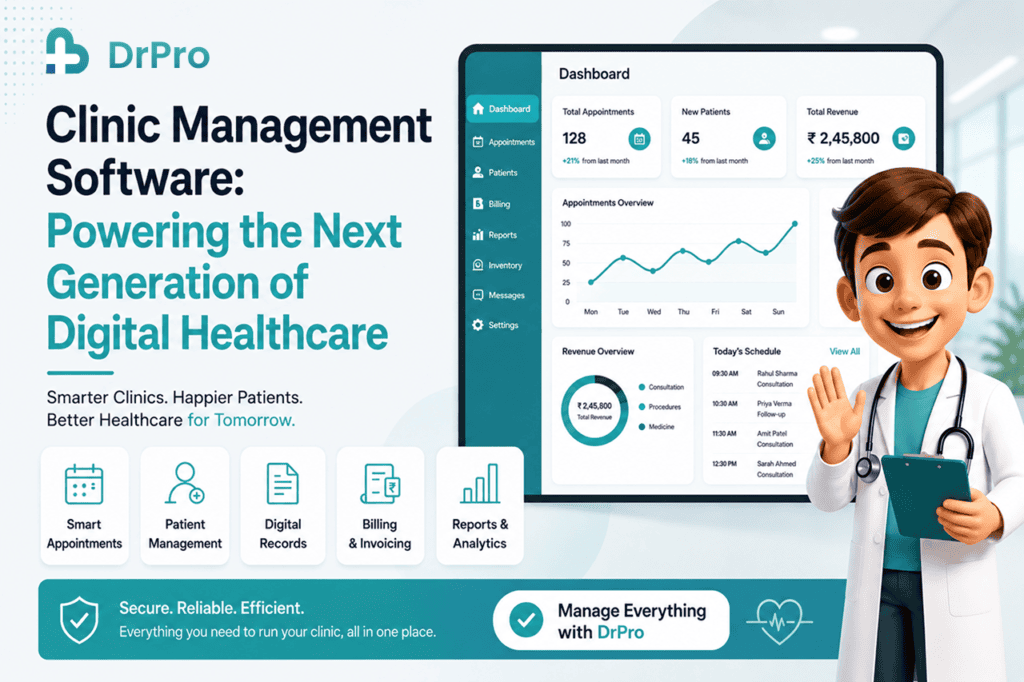
Some features of an all-in-one solution can be combined, such as:
- Patient registration and management
- Appointment scheduling
- Electronic Medical Record (EMR)
- Electronic Health Record (EHR)
- Digital prescriptions
- Billing and invoicing
- Laboratory management
- Pharmacy management
- Inventory management
- Telemedicine
- Patient communications
- Reports and analytics
By consolidating all of these elements, the clinic management software can eliminate duplicated administrative tasks and make access to the information that health professionals may require that much easier.
Why Is Digital Clinic Management Becoming Essential?
The number and complexity of the workflows handled within a healthcare provider are increasing. A single clinic, doctors, nurses, receptionists, laboratory, pharmacy, billing department, and patients may have to work together throughout the course of one day.
Clinics can face many issues when manual and siloed workflows are employed, such as:
- Missed appointments
- Long patient wait times
- Duplicate and fragmented records
- Billing discrepancies
- Heavy paper load
- Lack of timely follow-ups
- Low visibility into operations
A “digital” approach to clinic management can tie all these into one framework for clinical operations, thereby structuring everyday business effectively and creating new opportunities.
Key Features of Modern Clinic Management Software
1. Smart Appointment Management
Scheduling appointments forms the core of an efficient clinic workflow.
Centralized management of doctors and appointments, cancellations, rescheduling, and follow-ups can be handled with the current clinic management software for the clinic staff, and based on the software, online appointment booking for patients is also enabled.
Some of the functionalities that may also be available are as follows:
- Online appointments booking
- Doctors’ availability management.
- Automated reminders.
- Appointment reschedule management.
- Cancellation management.
- Queue managing.
- Follow-up scheduling and managing.
Managing appointments more effectively can be extremely important to minimize appointment clashes while also enhancing the patient’s workflow.
2. Centralized Patient Records
One of the primary elements of the management of healthcare that clinics need to consider is patient information.
There are now clinics which no longer keep files on paper or use several disconnected systems but keep all of their patient’s medical files on a digital system, in one single place,
which may consist of:
- Medical history
- Past consultations
- Prescriptions
- Diagnostic reports
- Allergies
- Treatment plan
- Follow-up information
- Billing history
Access to information for authorised staff. This system provides quick answers about medical data for anyone using it, which may allow for better decision-making during appointments.
3. EMR and EHR Management
Electronic Medical Records and Electronic Health Records are a crucial element of our digital health environment.
EMR/EHR functionality integrates with your clinic’s system to generate, house, update, and retrieve patient data digitally.
This can:
- Reduce your reliance on paper and physical files
- Streamline your filing systems
- Minimize manual error
- Provide more rapid retrieval of medical history
- Enhance cooperation between health care professionals
Digital records of your visit. It is also so helpful for growing practices as it helps them to deal with large patient lists as they increase. This keeps all patient records up-to-date and very efficiently organised.
4. Automated Billing and Payment Management
Financial management is another critical part of clinic operations.
Manual billing can require significant administrative effort and may increase the possibility of errors.
Clinic management software can automate several financial processes, including:
- Invoice generation
- Consultation billing
- Payment recording
- Receipt generation
- Outstanding payment tracking
- Financial reports
Billing linked to patient records & appointments. Streamline your financial workflow.
5. Digital Prescription Management
Medical doctors have a simple way of storing information of patient’s prescriptions when using e-prescriptions.
Doctors, using a health portal that is equipped with medical forms, can electronically prepare prescription forms and record medication history under their patients’ electronic profiles.
It’s a paperless operation that is useful when doctors want to scan their previous prescription cards for their new patients.
6. Telemedicine and Virtual Consultations
Telemedicine has influenced the way healthcare providers can care for patients.
Modern clinic management software can allow online consultations to be integrated with the daily running of the clinic, enabling providers to manage both in-person visits and remote visits.
Features of telemedicine could include:
- Booking of online consultations
- Online video consultations
- e-prescriptions
- Patient communication
- Reviewing and managing follow-ups
- Digital medical records
This offers patients another avenue to receive healthcare, and allows a clinic the ability to process appointments at a central station.
7. Patient Communication and Follow-Up
Good communication ensures a positive patient journey.
Routine messages are a way clinical management software can improve patient experience;
- appointment reminders
- follow-up notifications
- medication reminders
- billing notifications
- clinical communication updates
Patients are kept fully updated, and the administrative staff workload is decreased.
8. Laboratory and Diagnostic Integration
Various clinics indeed relies laboratory tests and diagnosis reports for proper patient management.
Bringing the laboratory service into clinical management software could allow a better integration of diagnostic data with patient records.
That is, doctors would not require manual transfer of the reports and could read the reports during the patient consultation directly.
9. Pharmacy and Inventory Management
Clinics that operate pharmacies or maintain medical supplies need accurate inventory information.
Modern software can help track:
- Medicine stock
- Product batches
- Expiration dates
- Purchases
- Sales
- Stock movement
Alerts can help employees monitor products that are running out or have passed their expiration dates, ultimately minimizing stock loss and waste.
10. Analytics and Reporting
Healthcare data can provide valuable insights into clinic performance.
Clinic performance insights can be gained through the facility’s data. Software used by a clinic
can produce detailed reports on: –
- Patient appointments
- Appointment trends
- Revenue
- Debts and outstanding payments
- Doctor appointment productivity and efficiency
- Appointment types and appointment consultation data
- Doctor performance rates
- Patient appointment retention rates
- Inventory utilization
These observations should aid clinic owners and managers in making smart decisions about clinic operations.
How Clinic Management Software Improves Patient Experience
Healthcare technology should not only streamline how healthcare works internally, but also the process of patient interactions.
A good clinic management system can assist in improving the patient journey in the following ways:
Quick Appointment Scheduling
A system allows appointments to be booked via online or digital interfaces, rather than solely over the phone.
Reduced Wait Times
Effective patient queuing and appointment management enable the clinic to process patients more fluidly, limiting idle time.
Quick Access to Records
Doctors can quickly access relevant medical details without having to rifle through files.
Improved follow-up communications
Automated appointment, testing, and consultation reminders improve patient follow-through.
Facilitating e-health
The use of telemedicine and digital communication channels allows patients and health care professionals to communicate more effectively while remotely situated.
The Role of AI in Clinic Management
The increasing role of Artificial Intelligence in modern healthcare.
AI provides an opportunity to reduce routine administrative burden, help uncover usage patterns, and extract insights to empower teams.
It has an application in:
- AI-enabled appointment scheduling
- Predicting patient flow
- Automated documentation
- Smarter patient engagement
- Predictive stock management
- Healthcare analytics
- Workflow automation
AI should supplement human doctors, not substitute medical judgment. A doctor is accountable for making a diagnosis and providing treatment.
Cloud-Based Clinic Management: A Growing Trend
Information storage and access are being revolutionized by the Cloud across the health service.
Using a cloud-based clinic management system enables designated users to retrieve necessary information from various locations and devices, irrespective of an organization’s local servers.
Some possible benefit includes:
- Centralized information
- Scalability
- Automatic updates
- Data backup
- Easier management of multiple sites
- Less hardware requirement
Healthcare enterprises looking to build a distributed footprint can also find tremendous benefits from using the cloud.
Security and Data Protection in Clinic Management
The health industry deals with personal data information; hence, data security is the main concern when opting for a clinic management software.
A health platform should possess necessary security features, for example:
- Controls for access to roles
- Authentication with high security to access the system
- Encryption of data
- Secure backups
- Monitor activity logged in the system
- Access rights management
- Disaster recovery
Providers also needed to review potential vendors’ security, applicable regulatory compliance standards, and requirements before adopting the software.
How to Choose the Right Clinic Management Software
It comes to know how to manage that aspect, is that there are so many factors, and the healthcare team decides on whether or not it’s important to integrate. So it must be fitting for the workflows of your business.
1. Identify Your Requirements
Identify weaknesses in your clinic, such as scheduling, charting, billing, inventory, or patient communication.
2. Evaluate Essential Features
Make sure the software provides the functions your clinic needs without unnecessary complexity.
3. Consider Ease of Use
The system should be utilized easily after providing sufficient training to the doctors, nurses, receptionists, and administrators.
4. Check Scalability
Select a solution that could cater to more doctors, departments, patients, or locations as the practice grows.
5. Review Integrations
See if the platform can connect to other labs, pharmacies, payment, telemedicine, or other health services.
6. Evaluate Security
Analyze your security settings, encryption practices, backups, authentication, audit logs, as well as the standards with which you must comply.
7. Assess Vendor Support
Long-term project success demands good assistance and training as well as support and maintenance.
Benefits of Modern Clinic Management Software
If applied properly, a Clinic Management Software can benefit healthcare organizations considerably:
For Doctors
- Quick access to all patient details
- Less need for documentation
- Improved doctor-patient interaction
- Easier prescription management
For Administrative Staff
- Easy appointment booking
- Automated billing
- Less paperwork required
- Improved communication with patients
- The whole of the communication with the patient
For Patients
- Simple to book an appointment
- Shorter waits
- Easier to reach you
- Easier for patients to get help
For Clinic Owners
- Better operational visibility
- Better financial performance
- Performance indicators (PI’s)
- Better to scale your business
The Future of Clinic Management
What will clinics look like in the future? AI, cloud computing, automation, interoperability, telemedicine, and real-time data will be shaping patients’ visits in the future, with their roles in managing a clinic.
Healthcare technology will become more connected, and clinical and administrative processes will be able to interact and communicate with one another better.
Future developments of managing a clinic will focus on:
- AI-driven clinical workflow
- Predictive analysis
- Smart patient engagement
- Automated administrative tasks
- Operational dashboards-real-time view
- Connected care systems
- Interoperable patient data; and
- Personalized and digital experiences
With the maturation of these technologies, there will be additional opportunities to improve efficiency within clinics while offering an even more accessible and patient-focused practice.
Conclusion
Clinic management software is an increasingly integral part of healthcare within the digital realm. A single integrated clinic management system brings together: appointments, patient records, EMR/EHR, billing, prescriptions, communication, inventory, telemedicine, and analytics. By doing so, healthcare institutions can streamline practice management.
A properly chosen clinic management system can significantly reduce administrative complexity, create a more coordinated patient experience and provider support, and yield better insight into your clinic’s operational efficiency.
As AI, cloud technology, and healthcare automation advance, a digitally integrated clinic management system will become even more integral for the future of the healthcare environment.
For institutions striving for operational improvements, selecting secure, user-friendly, scalable, and integrated clinic management software solutions could provide a crucial step toward more connected, efficient, patient-centric health care.