

Introduction
The healthcare sector is poised on the threshold of a technological revolution that is redefining the way hospitals are managed, care is provided, and the overall patient experience. In today’s environment of demanding patient expectations and stringent healthcare regulations, hospitals must employ smart, efficient solutions to streamline operations without compromising the quality of care.
This is precisely where Hospital Management Software plays a crucial role in today’s healthcare ecosystem. Going beyond being merely a digital administrative tool, this software lays the groundwork for networked, data-intensive, and patient-centric hospitals.Whether it’s automating cumbersome administrative tasks, aiding in efficient clinical decisions, or empowering staff with the ability to manage all patient data effectively, Hospital Management Software streamlines every process in a way that enhances efficiency, brings down costs, and ensures excellent patient care.
Why Hospitals Need Modern Hospital Management Software
Hospital Management: Thousands of patients’ lives, thousands of records, thousands of transactions, millions worth of medical supplies, and healthcare experts-all at the same time. Running a hospital isn’t just about healthcare, but effective administration. Managing these operations simultaneously is a herculean task.
Without proper management, most hospitals endure:
- Prolonged delays in treatment
- Manual errors while managing records and documentation
- Communication breakdowns across departments
- Revenue loss from inaccurate billing
- Inconvenient management of patient data and medical history
- Wastage of resources
Modern Hospital Management software connects every department to a secure, interconnected platform.
The Digital Transformation of Hospital Management
The Hospital Management software of the present day is not a simple administrator. It connects all functions related to the running of a hospital in a single intelligent ecosystem.
Hospitals can deal with all this:
- Patient registration & Admissions
- OPD & IPD Workflows
- Electronic Medical Records(EMR/EHR)
- Online Scheduling System
- Laboratory Management Module
- Pharmacy operational process
- Billing and insurance software
- Inventory and Asset Management
- Human Resource Management System
- Business intelligence reporting and analytics
By utilizing an integrated system, you enhance your collaborative opportunities and prevent duplication of activity, thereby increasing operational performance.
Key Trends Shaping Hospital Management Software in 2026
AI-Powered Healthcare Automation
AI empowers Hospital Management Software with automations of repetitive administrative procedures, enhances medical note-taking capabilities, and delivers predictive reports for efficient patient care practices.
Cloud-Based Hospital Management
The ability for hospitals to access patient data remotely via the cloud also means a scalable and fully updated solution, while allowing many different locations the ability to work together simultaneously.
Smarter Patient Experience
Modern software brings online appointments, e-prescribing, patient portals, automatic reminders, and faster discharge to provide you with a fluid experience when managing your healthcare.
Data-Driven Clinical Decisions
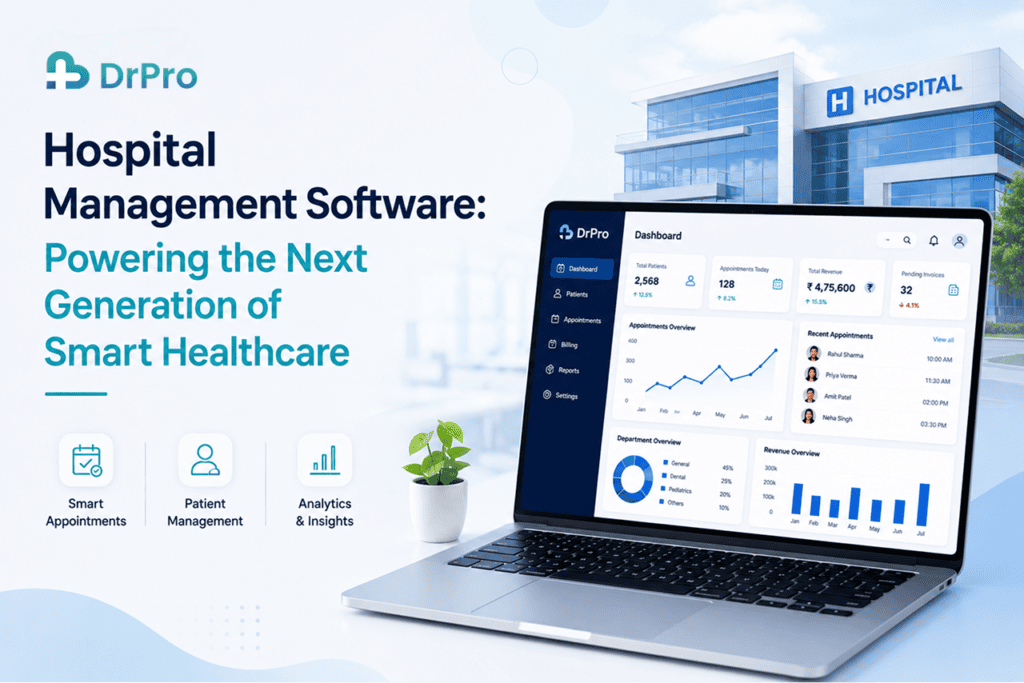
Provide real-time dashboards and analytics so that administrators of hospitals can keep track of patient flow, financial returns, resource usage, and the overall operations.
Integrated Digital Healthcare
This advanced software enables one platform to seamlessly integrate laboratories, pharmacies, diagnostic centers, insurance companies, telemedicine services, etc.
Essential Features of Hospital Management Software
The Essential Features in Hospital Management Software are:-
- Patient Registration
- Appointment & Bed Scheduling
- OPD & IPD Module
- EMR • EHR Integrated
- Lab Module
- Pharmacy Module
- Insurance & Billing Module
- Inventory Module
- Web App Development/Mobile Apps module
- Tally Compatible
- Telemedicine Module
- E prescribing. • ERPS
- HRM &payroll module
- Reports and analysis tool
- HIPAA compliance features
- Security
- Cloud Backups
- E prescribing
These help the healthcare organizations streamline their workflows, save resources, and maintain high standards of healthcare and service. This is helpful for the efficient and secure high-standard services to society.
Benefits of Hospital Management Software
Measurable advantages result across all layers of healthcare at your hospital when healthcare facility management software is implemented, as it can provide quantifiable gains all throughout every layer in the healthcare facility’s business endeavors.
Better Patient Care
Immediate patient access to healthcare practitioners for enhanced care. Enhanced care access saves healthcare practitioners with access to an extensive patient history, aiding diagnostic decisions, treatment plan and continuity.
Improved Operational Efficiency
When there’s automation, there’s less paperwork. There’s less chance for errors as well, and this process may smooth out any kinks across department operations.
Enhanced Financial Performance
With correct billing, inventory management, and revenue tracking, hospitals can increase their profitability.
Stronger Data Security
Sensitive patient data is protected by the latest encryption technologies, role-based access, and a robust, secure cloud environment.
Smarter Decision-Making
Real-time analytics enable hospital leaders to make better operational and strategic decisions.
Choosing the Right Hospital Management Software
Beyond these specific features, let’s look into other factors when hospitals are selecting a Hospital Management Software.
They need to be compared according to:
- Ease of integration
- Scalability
- Cloud features
- Artificial intelligence (AI) capabilities
- Data security
- Standards
- Integration with existing systems
- Personalization
Support systems: Future-proof, agile solution adaptable to tech advances and organizational expansion.
The Future of Hospital Management Software
The healthcare is shifting into smart, intelligent, patient-centric, and interconnected ecosystems. Here are the most impactful upcoming changes we’re likely to see in hospital management software in the years to come:
- Artificial Intelligence (AI)
- Predictive Healthcare Analytics
- Internet of Medical Things (IoMT)
- Remote Patient Monitoring (RPM)
- Digital Patient Portals
- Voice-Assisted Clinical Documentation
- Smart Hospital Infrastructure
- Paperless Healthcare
Hospitals need to take advantage of some (or all) of these advancements if they want to ensure better patient results while staying competitive in the long run.
Conclusion
The revolutionization of healthcare through tech with Hospital Management Software – A game-changer. By integrating the critical clinical, administrative, and financial management services, HMS help hospital’s run efficiently, enhance customer experiences, and ultimately give their best services. If the world and healthcare are heading towards an interconnected future with technology.
Then getting an excellent HMS application has become essential. It is more than upgrading your technology – getting HMS to invest wisely in the future of better, efficient, and customer-centric medical services.