

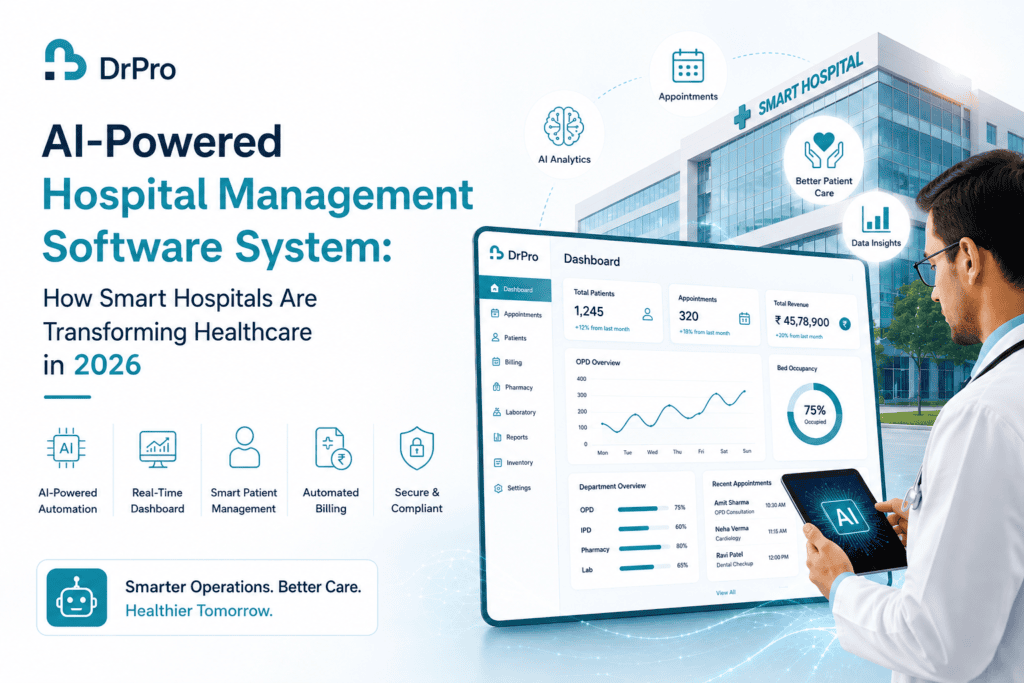
The landscape of healthcare has been evolving at an accelerating rate. Disconnected applications, manual processes, and paperwork are gradually giving way to unified, digital systems capable of streamlining the complex operations of the hospital or clinic. Central to this revolution is the hospital management software system.
The typical modern-day hospital management system connects virtually every facet of the hospital, including appointment scheduling, electronic medical records (EMR) and billing, lab and pharmacy services, supply management, hospital workflow, reporting, and much more.
Fueled by growing applications of AI, automation, cloud, and real-time analytics in the health sector, hospital management systems are entering a new era of connecting people to people in the health domain.
What Is Hospital Management Software?
What is hospital management software? Hospital management software is a software solution to help hospital manage their clinical, administrative, operational, and financial functions through a unified system.
Hospital management software enables connecting several important business processes rather than having a disparate collection of many disconnected software solutions for different departments.
Some of the modules in the contemporary hospital management system are:
- Patient Registration
- Appointment Scheduling
- OPD Management
- IPD Management
- Electronic Medical Records
- Doctors/Staff Management
- Billing & Medical Billing
- Pharmacy Management
- Lab Management
- Inventory Management
- Supplier Management
- Reports and Analytics
- Telemedicine
- Queue Management
- Patient Communication
The features may differ depending on the vendor that you choose; however, ultimately they all attempt to increase the efficiency, organisation, and integration of your hospital.
Why Hospitals Need Modern Hospital Management Software
The conventional ways of running a hospital include managing numerous paper documents, filling them in manually, entering data into spreadsheets, telephone, and multiple applications which are disparate from one another.
With an increasing patient population, these systems become unmanageable:
A comprehensive hospital management software system can simplify your hospital management problems
- Long patient waits
- Duplicate data entry
- Manual invoicing
- Siloed departments
- Challenge tracking inventory
- Paper record keeping
- Lack of operational visibility
- Delayed reporting
- Problems with appointment booking
- Lack of communication
Many of these operations can be centralized by a hospital through digital transformation.
How AI Is Changing Hospital Management Software in 2026
AI is slowly growing to become an established sector within medical technology. With that said, when you mention AI in hospital administration, it’s not just about plugging in some chatbot to hospital software already in existence. More significantly, it means using data and automation somewhere within daily routines.
1. Intelligent Workflow Automation
There is a considerable volume of recurring administrative duties handled by hospital employees daily.
A set of workflows, such as scheduling, reminders, information management, reporting, and standard administrative functions, are handled well through AI automation.
Repetitive tasks are removed, and efforts are directed to high-value tasks.
2. Predictive Analytics
Hospitals produce enormous amounts of operational data.
AI-driven analytics can aid in pattern identification across such areas as:
- Patient volume
- Demand in terms of appointments
- Level of departmental activity
- Usage of supplies
- Trends in revenue
- Deployment of resources
Such information is capable of aiding in improved planning and an overall operational decision-making process.
3. Smarter Patient Flow
Hospitals need to improve efficiency within their facility, and this means that Patient Flow needs to take centre stage.
A hospital management system that connects appointment booking systems, registration software, waiting lists, room availability, pharmacy information, diagnostics, and the billing system can help.
If you make sure that the right hospital systems work together, then you’ll be able to better identify where your hospital processes are being slowed down.
4. AI-Assisted Documentation
Although documentation is a necessary process in healthcare, it is a time-consuming element and has the potential to detract from direct patient care.
AI-driven tools could be utilized to manage the organization of health information and take some of the administrative burden from health professionals without taking clinical decisions away from the health professional.
Essential Features of a Modern Hospital Management Software System
When selecting hospital management software, more than a list of capabilities should be investigated.
The program ought to accommodate the hospital’s entire operational stream.
Appointment Management
Appointment software can assist hospitals in managing schedules for doctors, patient bookings, cancellations, and reminders.
Using a single central booking system also aids in better communication.
OPD and IPD Management
A vast amount of information comes from the outpatient and inpatient departments.
To manage the process of registration, consultation, admissions, transfers, discharges, and other aspects of patients, a digital system would be beneficial.
Electronic Medical Records
Digital records will allow access and management of health information to authorized persons easily.
A well-developed system should include suitable levels of access controls to health information.
Medical Billing
Billing is another major hospital management function.
HMS software enables handling of billing, payment, service, and billing reports on this single interface.
Laboratory Management
Lab processes can include various steps in order to carry out the request for a test, processing of samples, final results, and reporting of results.
Integrated laboratory management can integrate diagnostic procedures with patients’ records and other areas of the hospital.
Pharmacy Management
Allows hospitals to track prescriptions, drug stock, sales, billing, and drug flow.
Streamlining pharmacy activities with other hospital departments can prevent rekeying of data and provide better visibility.
Inventory Management
Hospitals must account for medicines, medical supplies, equipment, and inventory.
A medical inventory system would assist in maintaining, tracking levels, purchasing, utilization, and suppliers of inventory within the medical organization.
Reporting and Analytics
Some dashboards and reports will show you data on patient volume, revenue, appointments, inventory, and departments.
Cloud-Based Hospital Management Software: The Next Step in Digital Healthcare
Cloud technology is gaining popularity among healthcare organizations.
Hospital management software, being a cloud-based system, can be easily accessed from wherever necessary and on desired devices by authorized personnel without much reliance on local server infrastructure.
Possible benefits are:
- Centralized information
- Scalable easily
- Management of multi-locations
- Remote access
- Easy software updates
- Centralized report
- Less dependency on local servers
Nonetheless, hospitals should examine aspects of security, privacy, data security, access control, backups, regulatory compliance, and business policies on the part of vendors before implementing any cloud service platform in health care environment.
How an Integrated Hospital Management System Improves Patient Experience
However, by the end of the day, Healthcare IT should primarily be about creating an easier patient experience.
Imagine the patient pathway:
Appointment Registration -> consultation -> Laboratory -> Pharmacy ->Billing ->Follow-Up
At each touchpoint, if each department is self-sufficient, patients and staff will be required to repeat information at every step of the process.
An integrated hospital management software solution can tie up these departmental workflows to ensure seamless coordination of patient services
Some benefits to a patient include:
- Easier to schedule an appointment
- Expedited registration process
- Less paperwork to fill out
Convenient access to health records online - Online consults
- Simpler billing process
- Reports available online sooner
- Appointment reminders
- Improved follow-up procedures
It’s not just about making the paper online. It is about improving the way patients experience health care.
DrPro: An AI-Powered Platform for Modern Hospital Management
As the demand for more interconnected, digital solutions in hospitals grows, platforms like DrPro provide these facilities with a unified workspace for their digital workflows.
DrPro is an AI Healthcare management Platform built for Hospitals, Clinics, Diagnostic Centers, Pharmacies, and healthcare practitioners.
A web platform that integrates various healthcare processes. It offers a combined platform for managing the following operations:
- Hospital Management
- Clinic Management
- Appointment Management
- OPD and IPD processes
- EMR/EHR
- Medical billing
- Lab management
- Pharmacy management
- Inventory management
- Supplier management
- Telemedicine
- Analytics and reporting
By bringing all these functions together, DrPro enables healthcare facilities to shift away from a collection of disparate systems in favour of a unified digital platform.
Why DrPro Can Be Considered for Digital Hospital Transformation
The real value of a hospital management software system is not based on how many features it offers. It’s the integration of those features that is crucial. Appointment features, for instance, can integrate with patients’ files, billing software, a laboratory’s workflow, a pharmacy, and even your hospital or clinic reporting systems.
When you adopt this interconnected way of working, your entire hospital’s digital workflows become that much cleaner.
Organizations seeking a hospital management solution that doesn’t require fragmented, disparate programs could benefit from learning more about DrPro and its array of hospital and clinic-related functionalities and workflow streams.
Hospital Management Software vs. Traditional Hospital Operations
| Traditional Hospital Operations | Modern Hospital Management System |
| Paper-based records | Digital records |
| Manual appointment booking | Online appointment management |
| Separate departmental systems | Integrated workflows |
| Manual billing | Digital billing |
| Spreadsheet-based inventory | Automated inventory tracking |
| Manual reports | Real-time dashboards |
| Limited data visibility | Centralized analytics |
| Repetitive data entry | Workflow automation |
| Difficult multi-location management | Centralized management |
Digital transformation can help hospitals to implement and optimize workflow and visibility management within their own organizational boundaries by moving away from traditional practices to digital systems.
How to Choose the Best Hospital Management Software System
There are seven schools of thought for hospital software solutions, each having merits.
It is important for hospitals to choose the best hospital software solutions by considering their specific department’s needs, size of the organization, workflow, budget constraints, internal technical infrastructure and technology support, long-range goals, etc.
What you should consider before buying…
1. Feature Coverage
Check if the software provides the modules and processes your hospital needs.
2. Ease of Use
But a potent framework is of no avail if it is tough for doctors, Nurses, Admin, employees, etc to utilize.
3. Scalability
It must be capable of supporting subsequent growth and be able to handle extra departments and locations when necessitated.
4. Security and Privacy
Healthcare data is vulnerable. Analyze authentication, authorization, access controls, backup, security protections, and associated compliance regulations.
5. Integration
Check if your platform can be integrated with other systems your organization uses.
6. Analytics
Investigate what kind of available reports or dashboards are helpful operationally.
7. Support and Training
Implementation doesn’t stop when the software is purchased. It should include training, technical support, maintenance, and updates.
Benefits of Implementing a Hospital Management Software System
Several advantages in terms of functioning can also be garnered from an adequately designed and run hospital management system.
Improved Efficiency
Automation may free up time from tedious administrative work.
Better Data Management
Centralized digital records make access to information simple to organize and use by authorised users.
Reduced Administrative Work
Digital workflows reduce paper use and time-consuming data entry.
Better Patient Experience
Web appointments, email interactions, and team-based work could improve patient convenience within healthcare.
Improved Operational Visibility
Dashboards & Reports: These can give administrators insight into the overall hospital operations.
Better Resource Management
The use of inventory management tools and operational analytics helps make a more informed resource plan.
Scalability
When healthcare organizations plan to move into a new location or add another service, digital platforms could give them a springboard into this growth.
What Is the Future of Hospital Management Software?
We will see a transition towards interconnected, intelligent, data-driven hospital operations.
It is expected that the following trends will determine the direction of systems for the next generation:
- AI
- Predictive analytics
- Cloud-based healthcare platforms
- Healthcare interoperability
- Digital patient engagement
- Automated workflows
- Remote healthcare
- Mobile health applications
- Real-time dashboards to monitor operations
- Hospital decisions based on data
More of a system will not make for a better one. Useful connections between them that are meaningful to actual healthcare institutions.
Conclusion
The healthcare industry is in the midst of a transition. It’s moving past simple digitization and evolving toward intelligent, connected hospital operations. Modern hospital management software allows organizations to consolidate appointments, patient records, billing, laboratory and pharmacy services, inventory, analytics, and multiple other workflows within a central digital platform.
When augmented by artificial intelligence, automation, cloud technology, and robust analytics, hospital management software can allow healthcare organizations to operate more efficiently, while also building a more streamlined and integrated experience for patients and clinicians.
Platforms like DrPro exemplify the transition towards unified healthcare management by integrating multiple hospital and clinic workflows onto one digital platform. The future of hospital management isn’t about simply switching from paper records to software – it’s about developing smarter workflows, enhancing connectivity between departments, implementing data-driven decision-making, and creating a truly patient-centric ecosystem. For organizations looking to develop a strategic plan for their next digital transformation, selecting an appropriate hospital management software system is a key step toward building a smarter hospital in 2026 and beyond.
Frequently Asked Questions
What is a hospital management software system?
A hospital management software system is a digital platform used to manage hospital operations such as appointments, patient records, billing, laboratory services, pharmacy, inventory, reporting, and other administrative and clinical workflows.
What are the benefits of hospital management software?
Hospital management software can help improve operational efficiency, reduce manual work, organize patient information, streamline billing, improve inventory management, support reporting, and create a more connected patient experience.
How does AI improve hospital management software?
AI can support hospital management through workflow automation, predictive analytics, intelligent reporting, data analysis, and AI-assisted administrative processes.
Is cloud-based hospital management software secure?
Security depends on the platform’s architecture, implementation, policies, and controls. Hospitals should evaluate encryption, authentication, access control, backups, privacy practices, compliance requirements, and vendor security before selecting a system.
Can hospital management software manage multiple departments?
Yes. Modern hospital management platforms can connect departments such as OPD, IPD, billing, laboratory, pharmacy, inventory, appointments, and medical records within an integrated environment.
Is hospital management software suitable for small hospitals?
Yes. Depending on the platform, hospital management software can be used by small hospitals, clinics, diagnostic centers, and larger healthcare organizations. The important factor is choosing a scalable system that matches the organization’s requirements.