

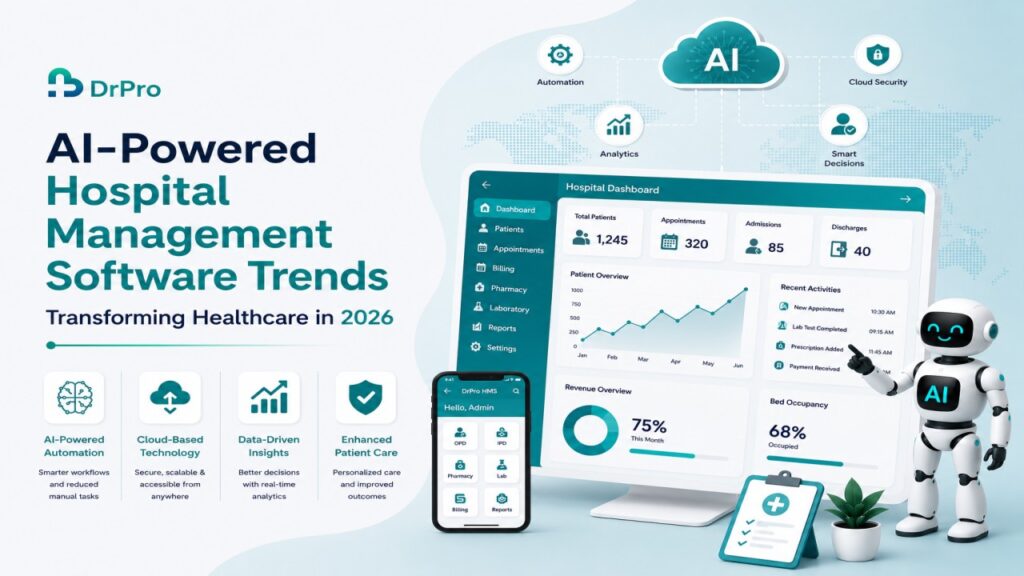
The global healthcare sector is going through a radical digital revolution, and it is Artificial Intelligence (AI) that is transforming the way in which hospitals across the world function. By the year 2026, AI-powered Hospital Management Software will have proven to be an indispensable technology in every hospital, clinic, diagnostic center, and all healthcare organizations for optimizing operational efficiency, patient satisfaction, and streamlining management tasks.
It is no longer possible for modern-day healthcare institutions to survive using the age-old management systems. Rather, these organizations have opted for an intelligent Hospital Management Software by leveraging and integrating advanced technology in terms of AI, Cloud computing, automation, and predictive analytics.
In this article, we will be discussing the trends that are changing the global healthcare industry in the year 2026 using the new AI-powered Hospital Management Software.
The Growing Importance of AI in Hospital Management Software
Healthcare providers currently manage immense amounts of data concerning patients, appointments, payments, reports from diagnostic laboratories, operations in the pharmacy, and the processes and procedures that take place in clinics and in hospital premises. Manual process, if not automated, contributes to a lot of operational drawbacks and deficiencies in workflow, such as long waiting times, operational complexity, etc.
The Artificial Intelligence integrated Hospital Management Software assists the healthcare organizations to effectively automate significant aspects of operation, reduce errors in performance, provide improved and effective decision-making capabilities to the health professionals, and render a quality patient experience. With the integration of these advanced and smart technologies into the health systems, hospitals can function in a much more organized manner without compromising the quality of patient care.
Top AI-Powered Hospital Management Software Trends in 2026
1. Intelligent Patient Management Systems
One of the greatest revolutions in Hospital Management Software is AI-driven patient management. Intelligent patient management software can efficiently manage patient registration, appointment scheduling, queue management, and communication.
The cutting-edge AI algorithms can forecast patient movement patterns and help in enhancing scheduling procedures for diminishing waiting times and hospital efficiency. Smart automation helps healthcare professionals give more priority to urgent cases.
Primary benefits:
- Efficient patient registration processes
- Improved patient appointment scheduling
- Reduced administrative load
- Enhanced patient comfort
- Better workflow management
AI-enabled Hospital Management Software is paving the way for organized and patient-focused service delivery by healthcare providers.
2. Predictive Analytics for Smarter Healthcare Decisions
Predictive analytics is revolutionizing clinical and operational decision-making in hospitals. Advanced Hospital Management Software can analyze records of patients’ records, treatment procedures, and diagnoses to determine health issues of patients in advance and predict the future.
The predictive analytics can help hospitals to:
- Diagnose potential diseases at an early stage
- Minimize the readmission rates of patients
- Make better treatment plans for patients
- Optimize hospital resource allocation
- Develop preventative healthcare strategies
With an AI-enabled system, healthcare professionals can take precise and quick decisions on the basis of real-time reports.
3. Cloud-Based Hospital Management Software Solutions
Cloud computing continues to dominate technology trends in the healthcare sector, even in 2026. Cloud-based Hospital Management Software has emerged as a vital technology as it enables remote and real-time access to patient health data and hospital management functions from a central location.
Compared to traditional systems, cloud-based platforms offer:
- Centralized patient data management
- Real-time access to patient data and hospital operations
- Lower cost of infrastructure and hardware
- Automatic software updates and maintenance
- Better departmental collaboration and data sharing
- Faster data back-up and enhanced disaster recovery
Multi-location hospitals and healthcare chains will especially gain from cloud-based Hospital Management Software because of its scalability and ease of access to information.
4. AI-Powered Medical Billing and Revenue Cycle Management
Accurate billing and proper revenue cycle management are still considered important problems for many hospitals. AI-powered Hospital Management Software automates billing tasks, processing of insurance claims, tracking of payments and revenue, as well as financial reporting.
Intelligent billing systems help healthcare providers:
- Minimize billing errors
- Speed up claims processing
- Optimize revenue cycle management
- Reduce claim denial and rejections
- Achieve improved financial transparency
The automation has the potential to reduce the administrative overhead.
5. Telemedicine Integration and Virtual Healthcare
Telemedicine is a major part of modern health care. Intelligent HMS can be customized to integrate telemedical solutions and services, which facilitate physicians and other healthcare professionals to provide virtual consultations and services.
The salient telemedicine features comprise:
- online appointment management
- video consultations
- digital prescription
- remote patient monitoring
- secure doctor-patient communication
The integration of AI can greatly assist physicians in understanding and identifying symptoms, retrieving relevant data about the patient’s health history, and performing preliminary diagnoses for the virtual medical consultation.
6. Smart Electronic Health Records (EHR) Management
The EHR system has also been upgraded after the integration of AI technology. The intelligent hospital management software can automate and manage patient records and update or fetch them quickly.
The AI-based EHR system has the following functions:
- Fast medical records management.
- Efficient diagnosis.
- Precise patient history maintenance.
- Lower documentation burden on doctors.
- Enhanced patient care co-ordination.
Through NLP (Natural Language Processing) and voice recognition, a doctor’s clinical document work can also be simplified.
7. AI Chatbots and Automated Patient Support
Intelligent HMS also comes equipped with chatbots powered by AI to cater to patient communication needs. Aiding in enhancing the flow of communication within and outside health organizations, these AI chatbots are programmed to address common queries from patients and visitors. They can;
- Provide instant answers to queries regarding any health issue
- Schedule doctor appointments
- Manage medication reminders
- Share helpful and important health-related data
- Respond to queries concerning bills and insurance coverage
This technology improves patient engagement while reducing pressure on administrative staff.
8. Advanced Cybersecurity and Data Protection
With the increase in the digital aspect of health services, it has become a key focus of utmost importance to keep the sensitive data of patients safe and secure. The AI-powered Hospital Management Software comes with sophisticated cybersecurity systems that help in recognizing and blocking any potential threats in real-time.
Features of modern cybersecurity infrastructure:
- AI-based threat detection and monitoring
- Multi-factor authentication
- Encrypted patient data
- Secure cloud storage for patient records
- Compliance with regulations
A strong cybersecurity infrastructure not only helps in safeguarding patient data but also allows healthcare organizations to ensure compliance.
9. Automation of Hospital Operations
Hospital automation is helping healthcare organizations to improve their productivity and minimize their manual efforts. AI-enabled Hospital Management Software automates many of the administrative tasks in hospital functions and operational duties in various healthcare setups.
Hospital automation includes:
- Staffing and scheduling
- Inventory management
- Pharmacy management
- Laboratory procedures and operations
- Patient discharge procedure
Automation increases the operational accuracy and efficiency while helping medical professionals concentrate on patient care.
10. Personalized Patient Care Through AI
Personalized healthcare is seen as a major aspect of the health sector by the year 2026. AI-powered Hospital Management Software can analyse and predict patient behaviors, medical history, lifestyle patterns, and health status, and formulate unique treatment plans that best suit their needs.
Advantages of personalized care:
- Enhanced treatment results
- Improved patient satisfaction
- Increased preventive care
- Precise medication prescriptions
- Effective chronic disease management
AI-driven personalization allows providers to focus on precise and efficient patient treatment.
Why Healthcare organizations are investing in AI-driven Hospital Management Software
The operational and clinical benefits provided by the AI-driven HMS make it a vital technology that healthcare organizations can invest in.
Key benefits are:
- Increased hospital efficiency
- Faster decision-making
- Increased patient engagement
- Decreased operational expenses
- Higher accuracy of data
- Efficient workflows
- Increased patient satisfaction
- Better healthcare outcomes
As the demands on the healthcare industry continue to rise, the intelligent Hospital Management software solution is critical for the sustainability of healthcare management.
Future of Hospital Management software in healthcare
The future of healthcare will focus on automation, artificial intelligence, cloud computing, and data-driven decision-making. Hospital Management software is predicted to become more sophisticated with new developments, such as:
- AI-driven diagnostics
- Real-time patient health monitoring
- Predictive disease management
- Robotic process automation
- Advanced healthcare analytics
The early adoption of modern HMS is going to be a significant competitive advantage to all healthcare organizations.
Conclusion
AI-powered Hospital Management Software is making hospitals and clinics efficient by improving their operations, patient care, and healthcare delivery. In 2026, it’s going to enhance all parts of Hospital Management, right from smart billing, AI-assisted prediction, integration with telemedicine, to automated processes. By adopting smart HMS, a clinic or hospital will find a new path to maintain sustainable growth and effective operation. The future of Healthcare belongs to a connected, intelligent, and AI-driven world, and Hospital Management software plays a key role.