
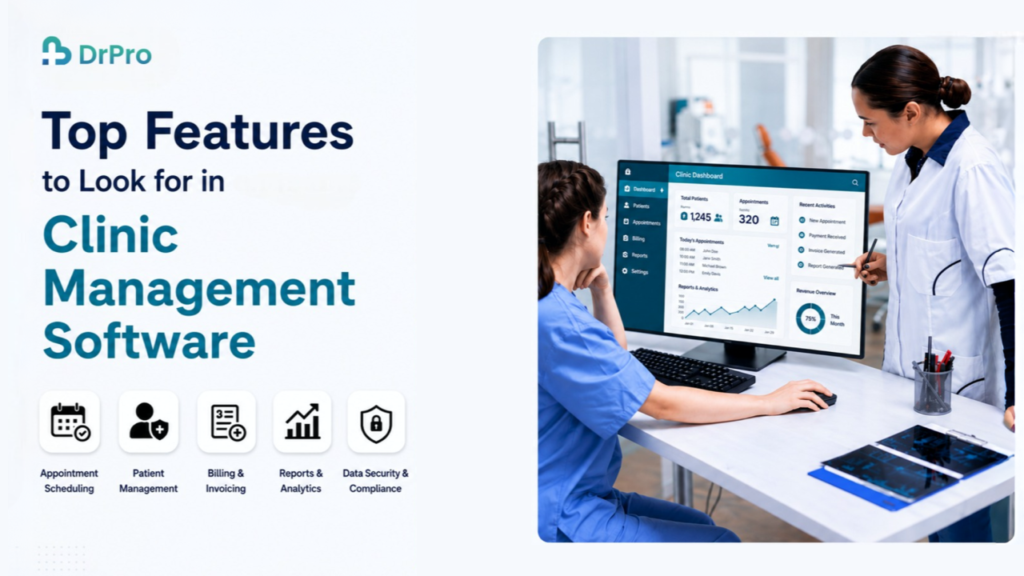
Today’s evolving healthcare sector needs the appropriate Clinic Management Software to facilitate clinic efficiency and elevate patient care. Smart digital systems are required for today’s medical practices and for simplifying the scheduling, billing, patient charting, and communication aspects while maintaining the clinic’s safety standards and efficient flow.
By implementing a fully functional Clinic Management Software, clinics can simplify their workflow and provide faster, smarter, and more organized patient care. As technology advances, the healthcare industry throughout 2026, AI-based and cloud-hosted clinic systems are becoming more widely used in clinics to enhance efficiency.
Below are the features any clinic should search for in their top clinic management software choices:
1. Smart Appointment Scheduling
Effective appointment management is a crucial part of a modern Clinic Management Software. Look for features like the ones listed below:
- Online appointment booking
- Automated text message/email appointment reminders
- Management of the doctor’s schedule
- Queue management
- Simple rescheduling/cancellation of appointments
Improved patient waiting time and workflow can be achieved through efficient scheduling.
2. Electronic Medical Records (EMR/EHR)
Electronic health records for patients are a must-have for present-day medical practice management.
A functional Clinic management software should offer features like:
- Secure the patient’s medical history
- e-prescription facility
- history of treatments
- diagnostic reports
- cloud storage of records.
EMR can enhance the accuracy of treatment and the access to patients’ data to health professionals instantly.
3. Billing and Invoicing Automation
Automated billing mechanisms assist clinics in managing their financial operations.
Key billing features:
- Invoice generation and sending to patients.
- Insurance claim handling.
- GST and tax computation.
- An online payment gateway for ease of transactions.
- Revenue tracking.
A smart billing system ensures minimal manual error and enhances financial transparency.
4. Cloud-Based Accessibility
Clinic Management Software is offered in a cloud-based access, which enables healthcare providers to view patient data securely from anywhere.
Some of the benefits include:
- Remote access
- Real-time synchronization of data
- Automatic data back-ups
- Multiple location management
- Collaboration among doctors and patients
Cloud technology enables clinics to be highly efficient and adaptable to a number of different situations.
5. Telemedicine support
The integration of telemedicine support has become a crucial element in a clinic management system. Some of the systems the software should include:
- Video calls for the patient and the doctor
- Prescription forms to be filled out
- Virtual follow-ups and analysis
Secure and confidential interaction with the doctor and patient
6. Integrated Pharmacy and Laboratory Management
An integrated health system increases coordination within clinics, pharmacies, and the laboratory.
Core functionalities should include:
- E-prescriptions
- Lab test management
- Medicine inventory control
- Instant report access and sharing.
These systems improve care efficiency, increase the speed of results, and support greater accuracy at the clinic.
7. Data security and compliance
Patient data is one of the most sensitive types of data within the health system and needs strong protection.
A good clinic management system should have:
- Data encryption
- Role-based access to information
- Cloud storage with security protocols
- Data backup and restore functions
- Adherence to health regulations
8. Mobile App Support
In today’s modern healthcare practices, it is essential that there is support for mobile services. A robust Clinic Management Software should offer the following mobile capabilities:
Book appointments for patients on their mobile device
- View medical reports on mobile devices
- Track prescriptions
- Provide instant notifications to doctors as well as patients
- Secure communication between patients and doctors
Mobile healthcare services allow for more ease of use for both physicians and patients.
9. Real-time Analytics and Reporting
With modern reporting functionalities available in advanced CMS applications, the business of healthcare and patient health management has become more accurate and result-oriented. These reports allow clinics to:
- Understand trends in patient intake
- Track financial reports (revenue reports, etc.)
- Measure appointment efficiency
- Review staff performance
- Monitor inventory levels
With real-time reports, clinics can more effectively plan operations and ensure consistent growth.
10. Easy to Use Interface
An easy-to-use system enhances work efficiency for staff members and significantly decreases training duration.
An ideal Clinic Management Software should offer:
- Intuitive navigation
- Quick system processing
- Simple design on the dashboard
- Easy work management
- Access on the move
Such a user-friendly software would bring seamless flow to the clinic operations.
Conclusion
Selecting a capable Clinic Management Software would greatly benefit the clinics wanting to elevate patient services, optimize clinic operations, and enhance healthcare productivity in 2026. A well-programmed modern Clinic Management Software should feature comprehensive services such as appointment scheduling, EMR/EHR features, automated billing process, remote consultations, cloud availability, and stringent security provisions. A high-end Clinic Management Software would help healthcare professionals to carry out faster, smarter, and more patient-centered health services. This could also aid the clinic’s growth in the long run.