

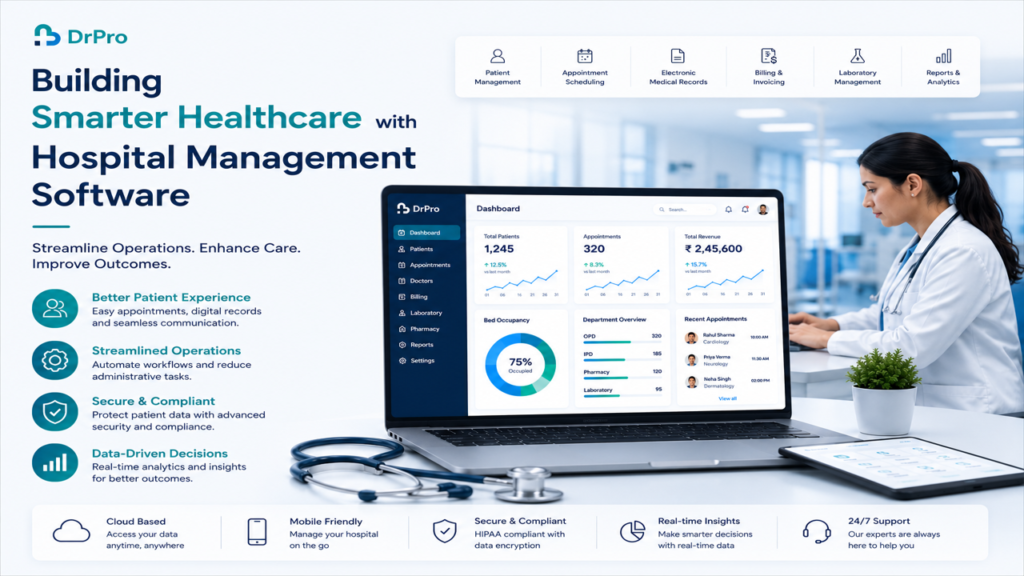
The digital revolution is transforming the healthcare industry, with efficiency, automation, and patient-focused care at its forefront. In 2026, a smart organization is heavily investing in modern Hospital Management Software to bring efficiency to operations, patient care, and hospital performance.
Traditional hospital setups deal with paperwork, delayed communication, redundant workflow,s and escalating running costs. Modern Hospital Management Software solutions address these issues with intelligent technology integration, combining AI, cloud technology, automation,n and real-time analytics into a one-stop healthcare solution.
Present-day hospitals, clinics, and healthcare providers require smart digital systems that can administer day-to-day hospital operations and also facilitate accelerated, safe,e and interconnected patient care.
What is Hospital Management Software?
Hospital Management Software is an all-inclusive health management solution designed to automate and effectively operate hospital services. It brings together all hospital departments, enabling providers of healthcare to handle hospital appointments, patient records, billing, laboratories, pharmacies, stock, CK, and operational administration on a single screen.
Some of the typical features offered in a modern Hospital Management Software include:
- Patient Registration
- Appointments Scheduling
- OPD/IPD Management
- Electronic Medical Records (EMR/EHR)
- Billing & Insurance Management
- Pharmacy Management
- Laboratory Integration
- Inventory Management
- Staff & HR Management
- Telemedicine facilities
These digital health systems assist hospitals by optimizing their overall performance, productivity, and administrative tasks, along with alleviating the workload associated with manual paperwork.
Why Your Hospital Requires Smart Hospital Management Software in 2026
With growing patient expectations and hospital operational challenges, manual systems often result in delays and information mistakes that directly impact patient care quality.
Contemporary Hospital Management Software addresses the above problem statement by automating complex procedures and enhancing workflow management.
Improved Operational Efficiency
With the automation of tedious administrative tasks (appointment scheduling, billing, report generation, patient follow-ups, etc.), hospitals can enhance their operations.
Medical staff can concentrate on what is most important – delivering effective and quality patient care.
Better Patient Experience
Patients expect faster and more convenient access to medical care. Smart Hospital Management Software provides a better patient experience by;
- Online appointment booking
- Speedier registration
- Digital prescriptions
- Quick billing
- Automated reminders
- Convenient access to medical history
This streamlined patient experience builds strong relationships with their healthcare providers.
Centralized Healthcare Management
Through a single center, the intelligent health management system links all the hospital departments in the central network.
The communication between the following parties becomes more convenient and efficient:
- Doctors
- Nurses
- Laboratory
- Pharmacy
- Billing department
- Administration department
Through the center integrated operation, communication loopholes could be avoided.
Key Features of Modern Hospital Management Software
AI-Powered Automation
The applications of artificial intelligence in hospital management are in the aspect of the automation of daily hospital operations:
- Intelligent appointment scheduling
- Automated billing function
- Reports generated by the intelligent AI
- Reminders of patient follow-ups
- Predictive health data analysis
This intelligent automation system could significantly cut down the chances of human error and increase the working efficiency.
EMR/EHR (Electronic Medical Records)
Electronic medical records have been indispensable for today’s healthcare practice.
EMR/EHR systems enable hospitals to:
- Securely store records
- Access the patient’s history immediately
- Increase diagnosis accuracy
- Minimize paperwork
- Optimize clinical decisions
It enhances coordination of care delivery.
Cloud-Based Accessibility
Cloud Based Hospital Management Software lets the health professional access patient information in a secure mode from any location.
Benefits:
- Real-time access to data
- Backups of data are automated
- Management of multiple locations
- Easier collaboration among
- all providersTelemedicine supporte.
Cloud technology adds scalability and flexibility to growing health organizations.
Smart Billing and Insurance Management
Electronic Financial management tools can make hospital billing straightforward.
This includes:
- Invoicing
- Processing insurance claims
- Monitoring payments
- GST & tax calculation
- Revenue reports
This enables a hospital’s financials to be more precise and takes administrative load off staff.
Telemedicine Integration
Telemedicine is an essential facet of current healthcare practice.
Modern HMIS allows for:
- Video consultation
- Online prescription of drugs
- Remote monitoring of the patient’s vitals and well-being
- Virtual follow-ups
This facilitates care provision outside a physical clinic setting.
Data Security and Compliance
Keeping patients’ details safe is a great concern in a hospital setting.
Hospital Management software with built-in security features has:
- Encryption of data
- Role-based access control
- Secure cloud storage
- Backups and restoration processes
- Standards of healthcare compliance
Robust systems in a hospital setting protect patient confidence while providing safekeeping of sensitive health records.
Benefits of Hospital Management Software
For the Hospitals
- Efficient workflow management
- Faster patient throughput
- Better use of resources
- Cost savings in operations
- Increased hospital productivity
For doctors
- Access patient records quickly
- Simpler scheduling of appointments
- More efficient diagnosis and treatment plans
- Reduced documentation work
For the patients
- Speedier delivery of health services
- Easy appointment booking
- Enhanced interaction with health services
- Enhanced health experiences
Future of Hospital Management Software
The future of healthcare is digital, connected, and smart.
The trends include:
- Automation by artificial intelligence
- Predictive analytics
- Medical devices powered by the Internet of Things (IOT)
- Mobile health applications
- Paperless hospital
- Smart health ecosystem
The health institutions implementing new Hospital Management systems are increasing in operational efficiency and are also improving the patient and technology aspects.
Conclusion
The modern Hospital Management Software has played a crucial role in transforming the hospital systems by increasing efficiency, automating the processes, and enhancing the care given to patients. AI-powered automation, cloud technologies, EMR/ EHR, and telemedicine will support hospitals in implementing a smarter and connected health ecosystem.
In 2026, as the health industry is evolving rapidly, the importance of adopting professional Hospital Management Software has become a must for any institution striving to optimize performance, reduce operational overhead, and maintain a high standard of patient care in a digital age.