

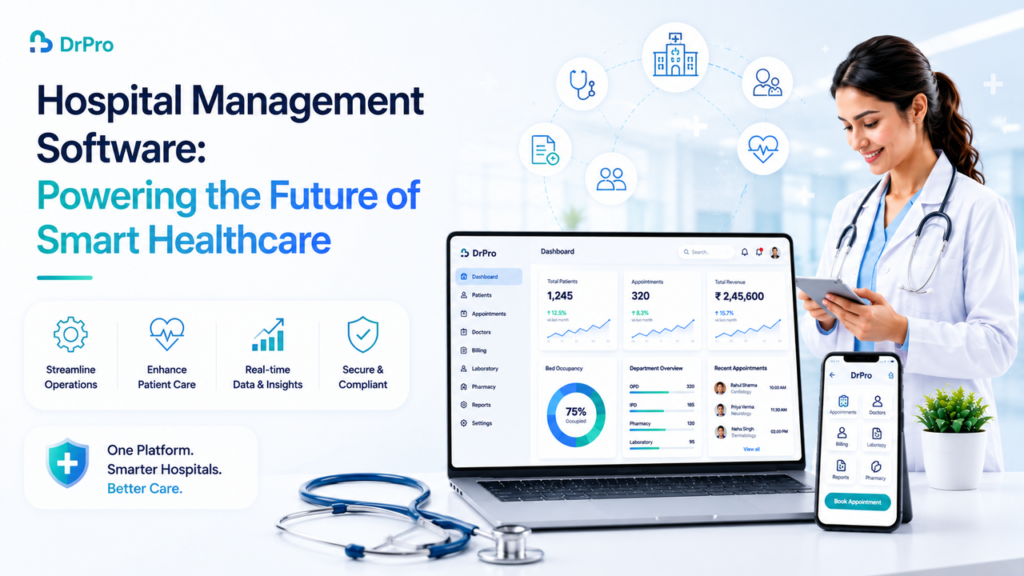
The world of healthcare is undergoing rapid revolution with innovations in digital technologies, automation, and intelligent healthcare solutions. By 2026, modern hospitals will have been relying heavily on advanced Hospital Management Software to deliver high-quality patient care, operational efficiency, and an interconnected healthcare system.
A conventional hospital system has the shortcomings of slow communication, excessive paperwork, inefficient processes, and ever-increasing operating costs. This problem is effectively managed by modern HMS in the form of centralized, cloud-based, and AI-powered solutions that cover each function in a hospital.
The ability to utilize a modern approach to healthcare is no longer a choice. In all aspects, hospitals and clinics are increasingly reliant on technology and smart, networked devices to operate efficiently, deliver quality and speed of care not seen before, remain patient-centered, and secure.
What is Hospital Management Software?
A Hospital Management Software is an all-inclusive healthcare solution that helps to manage hospital operations efficiently through one system. HMS integrates different departments within the hospital to simplify the complicated administrative and clinical tasks.
A modern Hospital Management Software typically manages:
- Registration of patients
- Scheduling appointments
- OPD and IPD management
- Electronic medical records management (EMR/EHR)
- Billing and insurance tasks
- Pharmacy and store management
- Lab integrations
- Inventory control
- Staff management
- Telemedicine feature.
Digitalisation of tasks within a hospital reduces manual errors, ensures better communication, and enhances the quality of patient services.
Why Modern Hospitals Need Hospital Management Software
Today’s health organizations are driven by rising patient expectations and high administrative workload. The manual process of handling patients and operations can lead to delays, errors, and inefficient patient service.
Today’s Hospital Management Software empowers hospitals to handle operations more efficiently and intelligently, while minimizing paperwork.
Improved Patient Experience
Patients demand quick, automated, and seamless healthcare services.
With HMS, hospitals can enhance patient satisfaction:
- Online appointment booking
- Faster check-ins/regulations of patients
- Digital prescriptions
- Automated appointment reminders
- Access to medical history
- Decreased waiting periods
Improved patient experience helps hospitals maintain positive patient relations and reputation.
Smarter Hospital Operations
Today’s hospital requires perfect harmony between the departments.
Centralized HMS streamlines communication between:
- Doctors
- Nurses
- Laboratories
- Pharmacies
- Billing personnel
- Administrative divisions
It results in accelerated workflows and efficient patient care.
AI-Powered Healthcare Automation
Artificial Intelligence is playing an integral role in contemporary healthcare administration.
AI-powered Hospital Management Software facilitates the automation of:
- Scheduling appointments
- Billing operations
- report generation
- Follow up on patients
- Healthcare analytics
Automation leads to diminished administrative burdens and a higher concentration of medical professionals on patient care.
Key Features of Advanced Hospital Management Software
Electronic Medical Records (EMR/EHR)
Digital medical records increase the efficiency and accuracy of healthcare.
EMR/EHR enables hospitals to:
- Securely store patient records.
- Access medical history quickly.
- Make diagnoses and plan treatments.
- Decrease administrative burdens.
- Encourage clinical collaboration.
Digital records are turning into building blocks for digital health systems.
Cloud-Based Accessibility
Hospital Management Software accessible from the cloud enables healthcare professionals to securely manage hospital data from anywhere.
Advantages:
- Enable real-time access to data.
- Enable remote healthcare management.
- Enable automatic data backup.
- Enable management of multiple hospital locations.
- Offer increased operational flexibility.
Cloud technology can streamline healthcare operations.
Smart Billing & Insurance Management
Automated billing increases efficiency in hospital finance management.
Key features of the systems:
- Invoice preparation
- Insurance claim management
- Payment status monitoring
- GST and tax processing
- Revenue report generation
Smart billing helps to minimize errors and enhances finance visibility.
Telemedicine Integration
Telemedicine is a must-have service for hospitals in 2026. Key features supported by modern HMS include:
- Video consultation
- Online prescription and referral system
- Virtual patient follow-ups
- Remote patient monitoring
Telemedicine can help hospitals offer remote healthcare services.
Data Security & Compliance
In today’s world,d it is extremely important that patient data is secured.
Secure Hospital Management Software includes:
- Encryption of Data
- Role-based Access control
- Secure Cloud Storage
- Backup and recovery of data
- Standards for compliance in Healthcare
A secure system will enable hospitals to secure the data of their patients and retain their trust.
Benefits of Hospital Management Software
For Hospitals:
- Increased efficiency in the work process
- Improved patient processing speed
- Optimized utilization of resources
- Decreased costs of operations
- Enhanced interaction between departments
For Doctors:
- Instant availability of patient records
- Simple work scheduling
- Better treatment plans
- Reduction in the work of the administration
- Patient’s quick access to treatment services
- Easy appointment and treatment schedules
For Patients:
- Speed in health services offered
- Simple booking and management of appointments
- Clear communication between doctors and patients
- Higher quality of health services and care
Future of Hospital Management Software
The future of health is intelligent, agile, and interconnected.
Key trends shaping modern healthcare include:
- AI-driven hospital automation
- Predictive healthcare analytics
- IoT-enabled health devices
- Mobile health applications
- Paperless hospitals
- Smart health ecosystem
By utilizing contemporary HMS solutions, healthcare organizations can develop future-ready hospitals that streamline healthcare delivery to patients.
Conclusion
The modern hospital management software revolutionizes healthcare through a focus on optimizing hospital operations, enhancing the level of care provided, and enhancing hospital productivity. Driven by AI-powered automation, cloud accessibility, EMR/EHR integration, telehealth features, and robust data security, the healthcare facility can foster a smarter and more connected future for healthcare.
The digital transformation of healthcare is progressing forward in 2026, and hospitals and healthcare facilities can secure their position within this evolving and expanding sector by investing in professional hospital management software.