

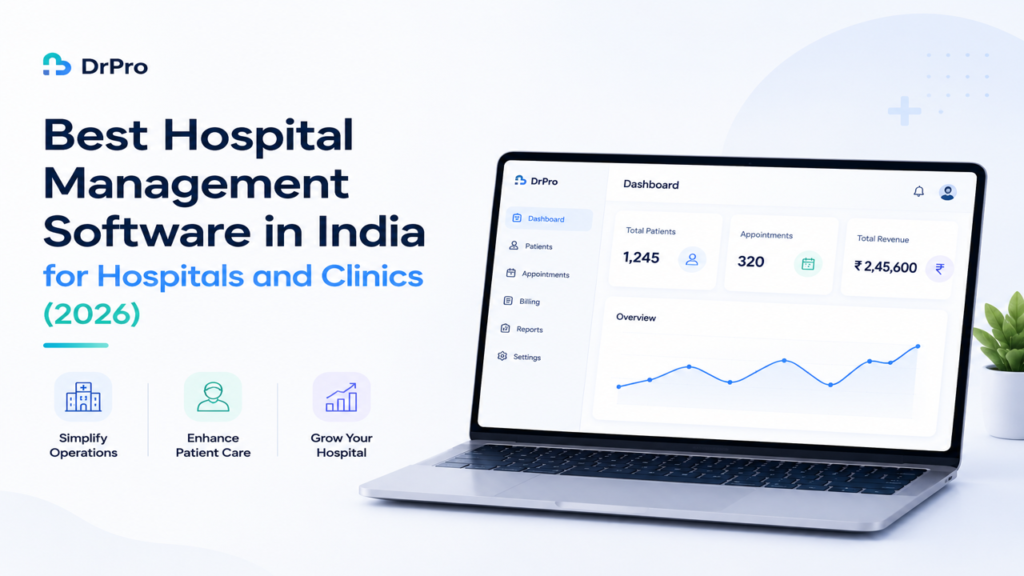
The Indian healthcare sector is changing very fast. Indian hospitals and clinics are already stepping forward to adopt digital solutions that help in enhancing the treatment services provided to the patients, streamlining the hospital processes, and improving other efficiency factors. In today’s digital world of healthcare, it is not an option, but a requirement to implement the appropriate Hospital Management Software.
Contemporary hospitals struggle with increased patient flow, increased complexity in the working operations, the need to adhere to regulatory standards, and the requirement for seamless patient flow. With a functional Hospital Management Software solution, a health organization can tackle these issues by creating and managing patient care, operational tasks, and financial aspects in one system.
Why Hospital Management Software Matters in 2026
Today, healthcare providers have to deliver quality care and operate efficiently at the same time. However, due to manual work and dispersed systems, there are delays, and administrative work and errors also increase.
A modern Hospital Management Software can assist a hospital or clinic by:
- Reducing routine administrative workload
- Increasing patient engagement and satisfaction
- Improving clinical decision making
- Simplifying billing and financial management
- Providing better management of medical records
- Bringing more transparency into operations
- Enabling health decisions based on data
With the growing trend of digitalization in the health sector, hospitals require intelligent software that can keep pace with patient and operational changes.
Key Features of the Best Hospital Management Software
Comprehensive Patient Management
The first step to excellent care delivery is creating an efficient patient management system. This is achieved through:
- Digital patient registration
- Appointment management
- Patient history tracking
- Treatment monitoring
- Follow-up system
This enables providers to provide customized yet efficient treatment to patients.
Electronic Medical Records (EMR/EHR)
Digital medical records facilitate instantaneous and secure access to medical details by healthcare providers. Some of the advantages of these records are:
- Quicker diagnosis and medical support
- Enhanced coordination of care
- Reduced physical paperwork
- Improved patient security
- Data safety and security
Smart Appointment Scheduling
Systems to simplify the appointment booking process and provide ease for the patients.
Features include:
- Online appointment booking
- Doctor Calendar management
- Automated reminders
- Queue management
- Multi-specialty appointment scheduling
Billing and Revenue Cycle Management
The financial aspect of hospital operations needs to be accurate to maintain profitability.
Modern HMS includes;
- Automated billing
- Insurance claims processing
- Payment posting and reconciliation
- Reporting and Analytics
- Revenue monitoring
This allows the hospitals to reduce billing errors and increase their cash flow.
Integrated Pharmacy and Laboratory Management
Key capabilities:
- Pharmacy inventory control
- Electronic prescriptions
- Lab workflow management
- Automated report generation
- Real-time data sharing
Cloud-Based Accessibility
Healthcare data becomes easy, secure, and flexible with cloud technology.
Advantages include:
- Access data from anywhere
- Real-time data synchronization
- Automatic backups
- Manage multiple branches
- Lowered IT infrastructure cost
- Benefits of Hospital Management Software to hospitals and clinics
- Increased operational efficiency
Benefits of Hospital Management Software for Hospitals and Clinics
Improved patient experience
Patients are registered easily and swiftly; appointment scheduling becomes streamlined, and there is enhanced communication.
Efficient resource management
Hospitals can efficiently manage the infrastructure, equipment, staff, and supplies.
Enhanced data security
With a robust security system, patients’ data becomes more secure, and compliance can be maintained.
Accelerated decision making
Reports and analyses, in real-time, will provide significant data on the performance of the hospital and patient needs.
Current Trends in Hospital Management Software
Health tech is booming with exciting new features in the modern HMS. Some of them include;
AI Technology
AI technology includes automation in the processes of scheduling, billing, reporting, and patient communication.
Telemedicine Features
Virtual consultations and remote medical treatment are a fundamental part of modern healthcare services.
Mobile Healthcare applications
Allows for the management of various health care services from mobile devices.
Predictive analysis
Allows the prediction of patient load, effective utilization of hospital resources, and planning of future growth.
Paperless hospital activities
Digitized processes enhance efficiency and enable environmentally friendly practices.
How to Choose the Best Hospital Management Software in India
When choosing the right Hospital management software, there are a few things that need to be kept in mind by the healthcare organizations, such as:
- Scalability and growth potential
- User-friendly features and easy-to-operate interface
- Cloud-based features
- Data security standards
- Features like customization are available or not
- Compatibility and integration with other systems
- Availability of technical support and training, if required
- Cost-effective feature
The correct solution should address current business needs and help achieve long-term digital transformation.
Conclusion
As hospitals and clinics undergo digital transformation in healthcare, the market demand for high-performance Hospital Management Software in India keeps on increasing. A proper Hospital Management Software enables healthcare providers to take better care of the patient, improve workflow efficiency, optimize the finafinancial aspectsd achieve the highest level of business efficiency.
In 2026, the best Hospital Management Software solution is no longer just another management system-it’s an investment toward enabling more intelligent, faster, patient-centric care.